
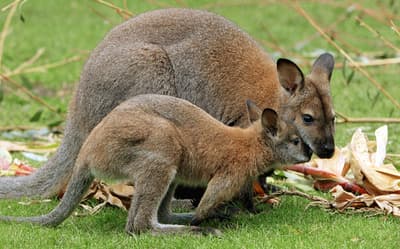
The forest of Rambouillet covers roughly 200 square kilometres west of Paris, in the Île-de-France region [1]. A wild group of up to 150 Bennett's wallabies lives in its southern half [1]. Cyclone Lothar struck the northern half of France on 26 December 1999 and the forest lost hundreds of thousands of trees [1]. The town of Rambouillet sits on the southern edge, 44.3 km southwest of the centre of Paris, and counted 27,224 residents in 2023 [3].
Seven wallabies arrived at a small zoological park in Émancé in the 1970s, a gift from the director of Basel Zoo to a friend who ran the place [4][5]. The animals were neither counted nor declared, and they got out [4]. Accounts of the forest state that the founders escaped from the Émancé park after a storm or through vandalism [1]. Their descendants have occupied the southern woods ever since [1].
A black nose, black paws and a white stripe above the lip identify the animals as Bennett's wallabies, the Tasmanian form of the red-necked wallaby, Notamacropus rufogriseus rufogriseus [2]. That subspecies is smaller than its mainland Australian relative and carries longer, darker, shaggier fur [2]. Adults weigh 13.8 to 18.6 kilograms and reach about 90 centimetres in head and body length, with males generally the larger sex [2]. A grizzled grey coat washed with red across the shoulders completes the markings [2]. They can live up to nine years [2].
The wallabies spend most of the daylight hours resting and move mainly at night [2]. They are largely solitary, gathering where food, water or shelter is plentiful, and they eat grasses, roots, tree leaves and weeds [2]. Two hundred square kilometres of woodland gives the group room to spread out [1].
A female's oestrus lasts 33 days, and the young stay in the pouch for about 280 days [2]. The Tasmanian subspecies breeds mostly between February and April [2]. Females may remain in their mother's home range for life, while males leave at the age of two [2].
Red-necked wallabies have been introduced to New Zealand, the United Kingdom, Ireland, the Isle of Man, France and Germany [2]. Bennett's wallabies were shipped from Tasmania as early as 1870 [2]. The Tasmanian animals have adapted to living near people and graze on lawns on the fringes of Hobart [2].
Infos Yvelines reports that the Rambouillet colony has fallen from more than 100 individuals [6]. Forest authorities and wildlife experts keep the animals under watch as a non-native species that could unsettle native flora and fauna [4][5].
For years the wallabies were treated as an urban legend in the Yvelines, and Infos Yvelines reports that the story was true [6]. The southern part of the forest is where the group lives [1]. The animals rest by day and move after dark, which keeps them out of sight [2].