There are many ways to answer an insult. You can ignore it. You can argue with it. You can outlive it quietly and let events do the work for you.
Caligula chose a different method. He built a bridge across a bay and rode a horse over it.
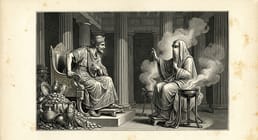
That sounds less like imperial policy than like a dare taken far too seriously, which is more or less the point. According to ancient accounts, an astrologer once said that Gaius, the future Caligula, had no more chance of becoming emperor than of riding a horse across the Bay of Baiae.[1] Then he became emperor. And after he became emperor, he ordered the construction of a huge pontoon bridge across that very bay and crossed it on horseback.[1]
This is one of those Roman stories that feels almost too perfect to be true. Prophecy. Mockery. Power. Engineering. Spectacle. Revenge performed as public works.
The Oracle Made A Very Specific Mistake
The line matters because it was not merely dismissive. It was imaginative. Plenty of people in history have been told they would never rule. Far fewer were told they had as much chance of ruling as they did of performing one absurdly specific act on horseback over open water.
That kind of prophecy gives the insult a shape. It creates an image. And once an image exists, a determined ruler can decide to inhabit it.
Baiae was not some random patch of water. It was one of the most fashionable resort areas in the Roman world, associated with luxury, elite villas, and imperial visibility.[1] To do something impossible there was not just to prove a point. It was to prove it where everyone important would hear about it.
The Emperor Who Took Metaphor Literally
Caligula’s reign is crowded with stories that make him seem theatrical to the point of unreality. That is part of the problem with him as a historical figure. He is filtered through hostile ancient writers, and hostility has a way of polishing every anecdote until it gleams.[1] But even allowing for exaggeration, the bridge at Baiae remains one of the most arresting episodes attached to his name.
He had ships assembled into a floating bridge stretching across the bay, creating what ancient writers treated as an astonishing feat of improvised engineering.[1] The structure was covered over so it could function like a road. Then Caligula crossed it in state, reportedly wearing the breastplate of Alexander the Great on one day and returning in a chariot on another.[1]
The effect was not subtle. It was not supposed to be. If someone had once said the thing could never happen, Caligula seems to have decided not merely to make it happen, but to make it unforgettable.
The Largest Pontoon Bridge In The Ancient Imagination
What makes the story so compelling is the scale. This was not a symbolic plank over a stream. It was a vast floating causeway across open water, built out of ships lashed together into a temporary bridge.[1] That detail changes the story from a personal act of spite into something bigger. Caligula did not just stage a stunt. He mobilized imperial resources to turn a taunt into infrastructure.
And that is a very Roman kind of madness. Rome was a civilization that loved visible proof of power. Aqueducts. Roads. Harbors. Amphitheaters. Caligula’s pontoon bridge fits awkwardly into that tradition because it was both a real engineering project and a piece of personal theater.[1]
It belonged to the world of construction, but also to the world of message-making. It said: the emperor can reorder matter itself to answer a sentence.
Was It Vanity, Strategy, Or Both?
One of the temptations with Caligula is to flatten every act into insanity. Ancient authors certainly encouraged that reading.[1] But the Baiae bridge works better if you see it as a fusion of motives instead of a single one.
Yes, it was vanity. Obviously. Yes, it was theatrical. Even more obviously. But it was also political. Roman emperors had to be seen. They had to embody luck, force, divine favor, and sheer capacity. To command soldiers or senators was one thing. To command the sea itself, or appear to, was something else entirely.
There is also the possibility that the bridge was a way of rivaling earlier displays of conquest and engineering, especially those associated with famous rulers and generals. Roman power was competitive even with its own past. Caligula did not merely want authority. He wanted scale, memory, and astonishment.
The Bay Became A Stage
That is what Baiae offered him. Not just water, but a theater. A natural space that could be converted into a spectacle of domination. Once the ships were in place and the roadway laid across them, the bay stopped being geography and became performance.
That matters because emperors rule partly through administration and partly through image. The bridge at Baiae was image turned solid. It was boast turned into architecture. It was the public announcement that under Caligula, even an insult could be redesigned as an event.
And in that sense, the horse almost becomes secondary. The horse is the punchline. The real point is that the emperor had made the whole bay cooperate.
Why The Story Endures
The episode has lasted because it compresses so much into one scene. It gives us Caligula the builder, Caligula the performer, Caligula the grudge-holder, and Caligula the emperor who understood that public memory is often built out of outrageous images rather than administrative competence.
It also survives because it captures something timeless about power. Ordinary people answer ridicule with words. Extremely powerful people sometimes answer it by rearranging the physical world.
That is why the story still has force. A man is told he will never be emperor. He becomes emperor. He is told he has as much chance of ruling as he does of riding a horse across a bay. So he builds a bridge across the bay and rides the horse.
It is childish. Grandiose. Logistically absurd. And, in its own way, chillingly effective.
The Roman Genius For Making Ego Monumental
Rome had a special talent for turning private ambition into public stone. With Caligula, that process often looked warped, but it was recognizably Roman all the same. His reign included multiple building projects, some useful, some self-serving, and some impossible to separate cleanly into either category.[1] The Baiae bridge sits at the far end of that spectrum, where engineering and ego become almost indistinguishable.
That may be the real reason the story survives. Not because it proves a prophecy wrong, though it does. Not because it shows off technical ingenuity, though it does that too. It survives because it reveals how emperors think when no contradiction feels binding anymore. If reality contains a metaphor that humiliates you, you do not argue with the metaphor. You pave it.
And so one of history’s most memorable acts of imperial pettiness became one of its most memorable acts of spectacle. Caligula did not merely outlive the oracle. He forced the oracle’s impossible image into existence and then rode through it.