In ancient Hawaiʻi, men and women ate meals separately under the kapu system, which governed Native Hawaiian life in every aspect [2]. Commoners and women were barred from foods that were rarely eaten or served only on special occasions [2]. Men did all of the cooking, and food for women was cooked in a separate imu before the sexes ate apart [4]. These rules shaped the feasts that later became known as lūʻau.
Radiocarbon dating published in 2010 places Polynesian arrival to the Hawaiian Islands at about 1219 to 1266 [1]. The settlers brought kalo, maiʻa, niu, ʻulu, puaʻa, moa, and ʻīlio, and they established settlements along coasts and larger valleys [1]. Taro and the poi made from it became the main staple, while pigs were raised for religious sacrifice and their meat was offered at altars [4][5]. Some of that pork was consumed by priests, and the rest was eaten in a mass celebration [4][5].
The ʻAhaʻaina Mawaewae, a feast for the birth of a child, required pig, mullet, shrimp, crab, seaweeds, and taro leaves [5]. Hawaiian feasts before the word lūʻau entered print were called pāʻina for smaller dinners or ʻahaʻaina for larger gatherings [2]. These feasts carried social and religious weight before the kapu system fell.
Kamehameha I had unified most of the islands by 1795 and completed the Kingdom of Hawaiʻi in 1810 [3]. In 1819, King Kamehameha II ate with women, ending the kapu and beginning the period called ʻAi Noa [2]. Messengers were sent over the islands announcing that eating was free and the kapu had fallen [2]. This moment is tied to the first lūʻau parties, with dinners or smaller gatherings called pāʻina and larger feasts called ʻahaʻaina [2].
The word lūʻau appeared in the Pacific Commercial Advertiser in 1856, when the paper described the wedding celebration of King Kamehameha IV and Queen Emma [2]. The palace grounds were opened to the native population, and visitors partook of a luau, or native feast, prepared for them [2]. A luau was also served at the residence of Dr. Rooke [2]. The modern name replaced ʻahaʻaina and pāʻina and came from a food always served at such feasts, young taro tops baked with coconut milk and chicken or octopus [5].
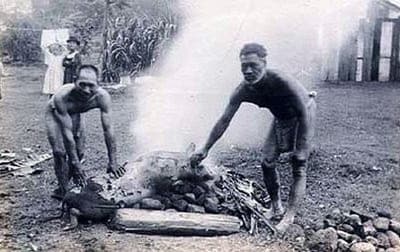
A lūʻau stew combines young taro leaves with octopus or chicken and coconut milk [2]. The highlight of many lūʻau is kālua puaʻa, a whole pig slow-cooked in an imu, and poi is made from taro roots [2]. Feasts were served on floor mats decorated with tī leaves, and utensils were absent, so everything was eaten by hand [2]. The thickness of poi was identified by the number of fingers needed to eat it, from three-finger poi with the thinness of applesauce to one-finger poi that was often freshly pounded taro [2].
In Encino, California, a 1946 Life article showed one of Donn Beach's lūʻau [2]. Beach is credited with popularizing and commercializing lūʻau in the continental United States, and in a 1986 interview he described shaping private home lūʻaus into larger public affairs with singers such as Alfred Apaka [2]. Lūʻau-themed parties range from affairs that ship food from the islands to backyard gatherings with artificial lei and Mai Tais [2]. An open outdoor area is essential because lūʻau are celebrated under large tents [2]. Lei made from flowers, ferns, tī leaves, or kukui nuts are common, and guests may make their own [2]. Live music often follows kanikapila style with ukulele, guitar, and sometimes drums, and hula dancers perform [2].