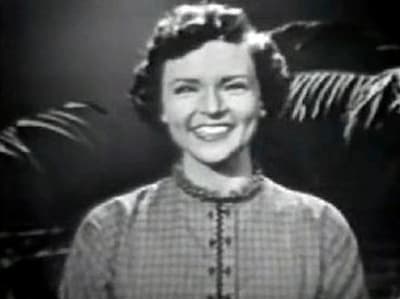
Before Betty White became the sly grandmother, the game-show assassin, the woman who seemed to enter American culture already fully formed, she was doing something much stranger and much harder.
She was on live television for five and a half hours a day, six days a week.
Not for a special event. Not for a telethon. Not as a stunt. As her job.[1]
It is difficult to explain just how absurd that sounds now. Modern television is edited, polished, cut into segments, padded with writers, graphics, and commercial breaks calibrated down to the second. Hollywood on Television, which ran from 1949 to 1953, belonged to a different species entirely. It was built in the wild early years of TV, when the medium was still figuring out what it even was, and one of the people helping invent the answer was Betty White.[1]
Television Before Television Knew Itself
When Hollywood on Television began in 1949, television was still close enough to radio that much of it felt improvised, provisional, almost homemade. The show aired live out of Los Angeles and originally starred radio disc jockey Al Jarvis alongside Betty White, who at the time was still a newcomer rather than a national institution.[1]
And the schedule was punishing. The program ran five and a half hours a day, six days a week. That adds up to thirty-three hours of live television every week, a volume so extreme that it sounds less like a show than a siege.[1]
What matters here is the word live. There was no safety net in live television, especially not in the early 1950s. If something lagged, you filled. If something broke, you smiled through it. If energy dipped, you generated more. The show was not built around perfection. It was built around the fact that the camera was on, and so you had to keep going.
The Job Was to Keep the Air From Feeling Empty
That is the hidden skill in early television. Not glamour. Not punchlines. Not celebrity. Endurance.
At first, White was co-hosting with Jarvis, which at least meant the burden of all that airtime was shared.[1] Then, in 1951, Jarvis left. His replacement was Eddie Albert, already a film star, and even he lasted only six months.[1] Thirty-three hours of live, ad-lib television per week, with almost nothing to hide behind, turned out to be the sort of assignment that could wear down even someone already used to performing.
Albert resigned too.[1]
And then Betty White was left there alone.
This is the moment when the fact stops being charming trivia and starts looking historic. White, suddenly carrying the show herself, is widely believed to have become the first female television talk show host.[1] Not because someone ceremonially crowned her with the title, but because the work itself forced the category into existence. Television needed a host. The host standing there was Betty White. So Betty White became the thing.
Imagine Talking to America for Hours
There is something almost surreal about the image: Betty White, in the infancy of television, speaking directly into the camera lens for hours at a stretch.[1] Not dropping in for a tidy twelve-minute monologue, not anchoring a neatly produced hour, but holding the attention of an audience in real time across a vast, hungry block of the broadcast day.
This is not just performance. It is presence. It requires a kind of emotional stamina that television later worked very hard to disguise with format. When people talk about charisma, they usually mean someone who lights up a room. What White demonstrated was something rarer: the ability to keep a room lit when there was no script, no exit, and the day still had several hours left in it.
Eventually the show adapted. It began bringing in guests for White to interact with, and over time it added more structured elements rather than leaving her to carry so much of the runtime through direct address alone.[1] That shift makes perfect sense. Human conversation is easier to sustain than a monologue. Variety helps. Segments help. Guests help. In a way, the format was evolving around the limits of what one person could reasonably be asked to do on live television.
But the remarkable thing is that those limits had already been pushed so far.
Why This Was Bigger Than a Curiosity
It is tempting to file this away as an antique oddity from the primitive age of TV. Look how strange the old days were. Look how unformatted. Look how long. But that misses what was actually happening.
Hollywood on Television was part of the moment when American television was inventing its own grammar, and Betty White was not merely present for that invention. She was one of the people helping write it in real time.[1]
The talk show, as we understand it now, depends on a set of assumptions: a host who can steer the room, improvise, connect with guests, fill dead air, recover from awkwardness, and make the viewer feel personally included in the exchange. White was doing those things before the role had fully settled into recognizable form. She was not stepping into an established template. She was helping prove the template could work.
And she was doing it in a medium that still felt unstable enough that the host’s personality mattered enormously. In early television, there were fewer layers between performer and audience. If the person on screen was dull, the show sagged. If the person on screen was nimble, warm, and quick enough to make hours feel inhabited rather than merely occupied, the medium itself started to feel alive.
Betty White could do that.
The Betty White People Forgot Before They Remembered Her
Later generations would know White as funny, durable, and almost uncannily modern in her timing. What Hollywood on Television reveals is that long before she became a beloved elder stateswoman of comedy, she had already survived one of the most brutal training grounds the medium could offer.
There is a reason her career felt so effortless later on. It was built on the kind of workload that makes “effortless” possible. If you can hold live television together for five and a half hours a day, six days a week, you are not just talented. You are trained at a level most performers never have to reach.
That early stretch also helps explain why White mattered beyond nostalgia. She was not simply a star who lasted a long time. She was one of the architects of the early medium, one of the people who helped turn television from a technical novelty into a human habit.
And she did it while carrying a schedule that sounds, even now, faintly impossible.
Why the Story Still Lands
People love this fact because it compresses two surprises into one. First, that Betty White was there that early, not as a footnote but as a central figure. Second, that television once demanded something so relentless from its hosts that it feels almost inhuman by modern standards.
Five and a half hours a day. Six days a week. Live.[1]
That is not just an impressive line on a résumé. It is a glimpse into an era when television was raw enough to be dangerous, elastic enough to be invented on the fly, and dependent enough on personality that one woman, talking into a camera for hours, could help define what the medium would become.
Which means the real story is not simply that Betty White hosted an impossibly long talk show. It is that, in doing so, she helped prove what a television host could be at all.