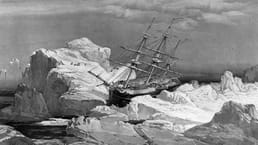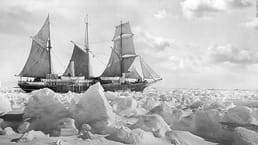
On October 24, 1871, American explorer Charles Francis Hall returned to his icebound ship Polaris in northwest Greenland after a two-week sledge trip. Commanding an expedition toward the North Pole, he entered his warm cabin in heavy furs and drank hot coffee. Within minutes he had a severe headache, dizziness, and vomiting, and by evening his left side was paralyzed. Over the next two weeks, slipping between lucidity and delirium, Hall accused his crew, especially physician and chief scientist Emil Bessels, of poisoning him.[2][3]
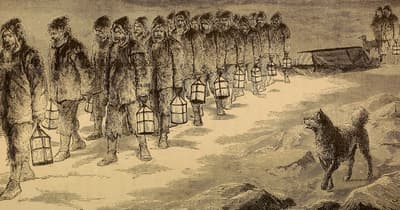
Early on November 8, 1871, Hall died aboard Polaris, and his men hacked at frozen ground ashore for four hours to dig six inches before finishing a two-foot grave the next day. In Bessels's account, on November 10, the crew hauled his flag-draped coffin across the snow on a dog sledge lit by lanterns, though another officer recalled the burial a day later.[3]
Why the Navy Ruled It a Stroke
By the time survivors reached home, the Polaris voyage had come apart. Hall had quarreled bitterly with sailing master Sidney Budington and Bessels. Afterward, nineteen people were separated onto an ice floe and drifted about 1,300 miles for six months before rescue off Labrador, while the ice-damaged ship was run aground.[2]
During the 1873 Navy Board of Inquiry, survivors reported Hall's accusations and noted he seemed to improve while refusing Bessels's care, then relapsed once treatment resumed. Bessels testified Hall died of "apoplectical insult," a stroke.[1][3] In December 1873, the Army and Navy Surgeons-General agreed he died of natural causes and called Bessels's care "the best practicable under the circumstances."[3] In 1875, four years after Hall's death, a British polar expedition set a bronze plaque at his grave honoring the captain who "sacrificed his life in the advancement of science."[1]
What a 1968 Autopsy Found in the Permafrost
That plaque stood over Hall's grave for nearly a century, until Dartmouth College English scholar Chauncey Loomis began Hall's biography and decided the testimony left murder plausible. In August 1968, with Danish permission, Loomis flew to Thank God Harbor with pathologist Franklin Paddock. Because permafrost preserved the coffin, flag shroud, hair, and fingernails, Paddock spent three hours straddling the coffin to gather samples before reburial.[1][3]
In Toronto at the Centre of Forensic Sciences, analyst A. K. Perkons sliced a fingernail into segments for neutron activation testing. Arsenic rose from 24.6 parts per million at the tip to 76.7 parts per million at the base, above the 22.0 parts per million in grave soil. Because fingernails grow outward, soil contamination alone could not explain that gradient, pointing to large arsenic doses during Hall's final two weeks.[2][3]
Why the Case Still Refuses to Close
Finding that much arsenic undercut the stroke ruling, yet Loomis stopped short of calling murder proved, and his coauthored biography noted arsenic poisoning as cause of death could not be conclusively established. Arsenic was common in nineteenth-century medicines, including Fowler's Solution, and Hall kept his own medical kit aboard Polaris. While refusing Bessels's care, he might have overdosed himself.[1][2][3]
At the same time, Bessels had medical training, cabin access, and probable access to arsenic, and never reported giving Hall arsenic during the inquiry. He stopped Budington from tasting Hall's medicine and refused an emetic, though under a stroke diagnosis inducing vomiting could have been dangerous.[1][3]
Even a later personal clue fell short of proof: historian Russell Potter spotted an auctioned envelope from Hall to Washington sculptor Vinnie Ream, and surviving letters from both men to Ream led writers to suggest a possible rivalry alongside their shipboard feud. Loomis concluded that what actually happened aboard Polaris between October 24 and November 8, 1871, can never be entirely known.[3]
Sources
- Charles Francis Hall (1821-1871), Chauncey Loomis, Arctic Institute of North America, 1982.
- HALL, CHARLES FRANCIS, Ernest S. Dodge and C. C. Loomis, University of Toronto/Université Laval, 1972.
- Polaris: The Chief Scientist's Recollections of the American North Pole Expedition, 1871-73, Emil Bessels, translated and edited by William Barr, University of Calgary Press, 2016.