In the 1950s, IKEA founder Ingvar Kamprad concluded that hunger was the single biggest reason customers left his stores [2]. Shoppers who spent the longest in the warehouse, the ones most likely to fill a cart, were also the ones most likely to be lost to an empty stomach [2]. Kamprad's answer was to install food service in every store. Mashed dates the first IKEA cafes to 1958 [1], while Tabcut places the food rollout around 1960 [4].
Gerd Diewald, who ran IKEA's food operations in the United States, explained the reasoning: when you feed customers, they stay longer, talk through their potential purchases, and make a decision without leaving the store [1]. The company has kept that arrangement for decades. Roughly 650 million hungry shoppers spend close to $2 billion a year in IKEA food courts [1].
Chris Spear, a chef who worked in an IKEA food-service operation, described the pricing rule: each store aims to be the absolute lowest price on an item within a 30-mile radius, even if that means selling at a loss [1]. Tasting Table reports the same 30-mile standard, framed as a way to stop customers from leaving in search of a cheaper meal [2]. The food loses money. The furniture does not.
In 2025, IKEA stores welcomed 915 million visitors, the fifth consecutive year of growth, and IKEA.com drew about 4.6 billion visits in 2024 [3]. Food turnover reached 2.15 billion euros, and 93 percent of customers said they would recommend IKEA food to friends [3]. Tabcut calculates that the food operation, including related services, accounts for about 1.33 percent of the company's $47.6 billion in annual sales [4].
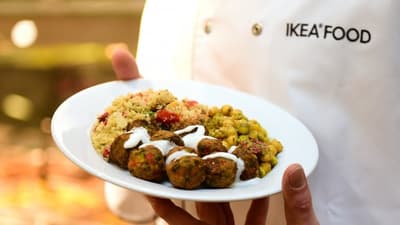
IKEA food executives call the meatball the best sofa-seller, a phrase that captures how a plate of food keeps a shopper in the market hall [1][3]. Tabcut counted 1.73 meatballs sold per second in 2023, more than 54 million across the year [4]. Influx puts global meatball volume at about one billion served annually [3].
In April 2018, Sweden's official Twitter account posted that Swedish meatballs are based on a recipe King Charles XII brought home from Turkey in the early 18th century [1]. The same account noted that lingonberry jam served alongside meatballs is about as Swedish as it gets. The rest of the menu is roughly 50 percent Scandinavian, with the remainder tailored to local markets [1]. Diners chasing the real thing can order gravad lax, the dill-cured salmon, or a kanelbullar from the bistro [1].
Two hot dogs, chips, and a soda cost $2.50 at the bistro [1]. That price lets families sit down, rest, and feed children before returning to the showroom floor, which Tasting Table credits with keeping families in stores longer [2]. Customers who eat without buying anything are not treated as a loss either, on the theory that they will come back when they need a sofa [1].