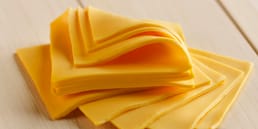
A salesman fastened pasta to a packet of Kraft cheese with a rubber band. The bundle was simple enough to look like a grocery-store improvisation, but Kraft saw something larger in it: a dinner that did not depend on a fresh cheese counter, a full icebox, or much money.[1]
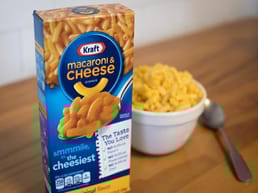
Kraft introduced its boxed macaroni and cheese dinner in 1937, selling it as a meal that could feed four people for 19 cents. In its first year, the quick, shelf-stable dinner sold about 8 million boxes, turning Depression-era thrift into a pantry staple.
Long before the box, macaroni and cheese already had a long paper trail. The earliest known recorded recipe dates to 1769, and the dish likely came from Northern Europe.[2] In the United States, one of its best-known early champions was Thomas Jefferson, who encountered fashionable pasta dishes in Europe, brought back noodle recipes and a pasta machine, and served macaroni and cheese at an 1802 state dinner.[2]
Jefferson's macaroni belonged to a world of imported equipment and well-supplied kitchens. Kraft Dinner landed in a different country. In 1937, families were still living through the Great Depression, and the pitch on the package was bluntly practical: four servings for 19 cents.[2] The product joined dried macaroni with a processed cheese component in a nonperishable package, so dinner could wait on a shelf until the household needed it.[3]
That shelf life depended on earlier cheese technology. James L. Kraft had patented a processed cheese method in 1916, helping make cheese products that could last longer than ordinary fresh cheese.[3] For a family counting coins, that mattered almost as much as taste. A box that would not quickly spoil was a small form of insurance.
The first box would not be mistaken for the one people recognize now. Kraft Dinner appeared in a yellow package with red lettering and navy blue accents, and it advertised a dinner for four in nine minutes.[4] The familiar blue box came later, after Kraft changed the package color in 1954 and made the color part of the brand's identity.[4]
World War II gave the product another use. With rationing in effect, fresh meat and dairy staples became harder to get, and the boxed mix kept gaining popularity.[2] One account notes that two boxes of Kraft Dinner could be bought for a single rationing coupon, and that sales reached 80 million boxes in 1943.[1] A meal built for Depression budgets also fit wartime cupboards.
The name changed as the product traveled. In the United States, Australia, and New Zealand, it became known as Kraft Mac & Cheese, while in Canada it remained Kraft Dinner, or KD.[3] The proposition stayed plain: dried pasta, cheese powder, and a meal ready in minutes.
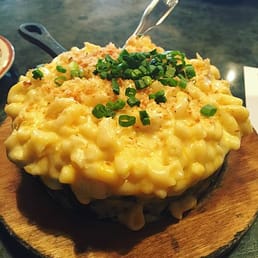
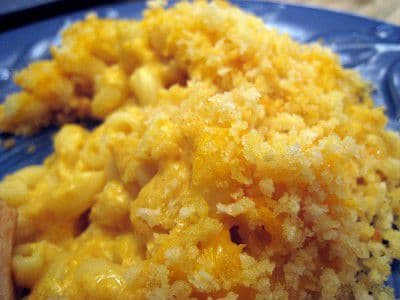
Restaurants and home cooks later dressed macaroni and cheese back up with brie, figs, mushrooms, bacon, breadcrumbs, and other flourishes.[2] The boxed version endured for a simpler reason. It answered the question at the stove on a thin-budget night: what can sit in the cupboard, cook quickly, and stretch across a table?
That answer was already there in the salesman’s little bundle, pasta on one side, cheese on the other, held together by a rubber band.