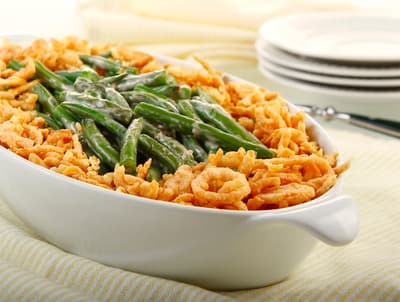
In 1955, Dorcas Reilly was working in a Campbell Soup test kitchen in Camden, New Jersey, with a plain assignment: make something quick enough for a newspaper feature, using ingredients an American home cook was likely to have nearby.[1] She and her team tried versions with celery salt and ham, then pared the idea down to green beans, mushroom soup, milk, seasoning, and a crown of packaged fried onions.[2]
Campbell’s estimates that 40% of its cream of mushroom soup sales go into green bean casserole, the 1955 Dorcas Reilly recipe that still appears at about 20 million U.S. Thanksgiving dinners each year.
The casserole began as product work, not as a family heirloom. Campbell’s had introduced cream of mushroom soup in 1934, then promoted it as both soup and sauce, a can that could bind a hot dish or casserole into dinner.[1] Food companies kept home economics departments for that reason, asking trained recipe developers to turn grocery products into everyday habits.[1]
Reilly’s recipe had to be fast, inexpensive, and built from familiar ingredients. Smithsonian notes that the postwar kitchen was ready for that kind of dish: canned goods were no longer rationed, frozen and canned foods were easier to buy, and more women were working outside the home while still carrying much of the responsibility for feeding families.[2] A side dish that could be stirred together and baked for about 25 minutes fit the hour.[2]
The Can That Became a Recipe Card
The first printed name was “Green Bean Bake,” which appeared on Campbell’s soup cans.[1] The name had the blunt usefulness of a package instruction. It did not promise elegance or regional authenticity. It told shoppers what to do with the can they had just brought home.
The classic version was almost stubbornly simple. Smithsonian lists six ingredients: Campbell’s cream of mushroom soup, milk, soy sauce, black pepper, green beans, and crunchy fried onions.[2] The beans could be frozen or canned, and the onions came pre-packaged.[2] The recipe lowered the threshold for cooking until it looked more like assembly, which was precisely its power.
Inside Campbell’s, the dish did not test especially well at first.[1] Reilly persisted, and the recipe eventually became one of the company’s most durable creations.[1] She later said she was “pleasantly shocked” by the public response, and proud of how popular it had become.[2] That was a modest description for a casserole that would become part of the American holiday reflex.
Why the Fried Onions Matter
Without the onions, green beans and mushroom soup might have remained another soft convenience-food side dish. Culinary historian Laura Shapiro called the crunchy topping a “touch of genius,” because it gave an ordinary casserole a bit of glamour.[1] The finished dish arrives creamy and pale, then breaks under the spoon with a salty crackle.
That texture helps explain why this particular test-kitchen recipe outlived so many mid-century package recipes. Campbell’s printed it on the can, and home cooks kept making it. By 2020, the company estimated that green bean casserole was served at 20 million Thanksgiving dinners in the United States each year.[1] Campbell’s also estimated that 40% of its cream of mushroom soup sales went into some version of the dish.[1]
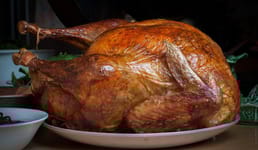
The number is the strange little proof of the casserole’s hold. A soup that could be eaten from a bowl became, for many shoppers, an ingredient with a holiday job. On Thanksgiving tables, beside the carved turkey and waiting pies, the green bean casserole still sits browned at the edges, its fried onions scattered over a dish invented to make one can of soup useful.