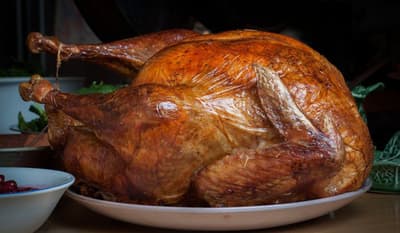
For a while, Swanson's mistake was not sitting quietly in a warehouse. It was riding the rails. The company had so much unsold Thanksgiving turkey in 1953 that, according to one account, the frozen birds were kept in ten refrigerated railroad cars, shuttled back and forth so the meat would not thaw while executives tried to decide what to do with it.[6]
Swanson's first TV dinner grew out of a 260-ton turkey surplus after Thanksgiving in 1953. The company turned the extra meat into turkey dinners packed in aluminum trays, then sold them as a frozen meal for the television age.
The surplus came to about 260 tons of frozen turkey, the result of a badly missed forecast of how many birds Americans would buy for Thanksgiving.[1] The holiday had passed. The next great turkey-buying season was almost a year away. Swanson needed a way to turn a mountain of frozen meat into something shoppers would want in December.
Frozen food already had a place in American kitchens. Smithsonian writer Owen Edwards remembered his working mother in suburban New Jersey treating Birds Eye frozen peas as a small mercy after a day at the office.[1] Swanson had also sold chicken and turkey pot pies, meals a household could heat with little preparation.[6] But a pot pie was still one dish. The unsold turkeys pushed the company toward something more complete.
Swanson salesman Gerry Thomas is usually credited with the solution. He later said he took inspiration from the neatly portioned meals served on airline trays.[3] He ordered 5,000 aluminum trays and helped assemble a familiar plate: turkey with cornbread dressing and gravy, peas, and sweet potatoes, with butter on the vegetables.[1] Smithsonian describes women on an assembly line portioning the food with spatulas and ice-cream scoops.[1]
The tray did real work. Pre-prepared frozen meals existed before Swanson's version, but Swanson brought the compartmentalized aluminum tray, already familiar from taverns and airplanes, into the home.[2] The little metal pan made the meal legible at a glance. Meat stayed in one space, vegetables in another, dressing in its own corner. It looked like dinner before it ever reached the oven.
The name helped sell the new habit. In 1950, only 9 percent of American households had a television. By 1953, that figure had climbed to 45 percent, and by 1954 it reached 56 percent.[2] Swanson called the product a TV dinner, linking frozen turkey to the glowing set that was rapidly becoming the center of the living room.
The advertising stayed close to midcentury respectability. One magazine ad described by Smithsonian showed a stylish woman in a green suit, feathered hat, and black gloves taking a TV dinner from a grocery bag while her husband sat smiling in the background with his newspaper. The line read, "I'm late, but dinner won't be."[1] The promise was hot food on time, with less work and no public admission that dinner had come from a mistake.
Swanson was reportedly unsure that even the first 5,000 dinners would sell.[2] That forecast missed too, but in the other direction. In 1954, the first full year of production, the company sold 10 million turkey dinners.[1]
The origin story has some wrinkles. Other accounts note that Swanson executives Gilbert and Clarke Swanson were also credited with the concept.[6] Still, the shape of the breakthrough is plain enough: too many Thanksgiving turkeys, an airline-style tray, an assembly line with ice-cream scoops, and a frozen meal carried from the oven to the small table in front of the television.