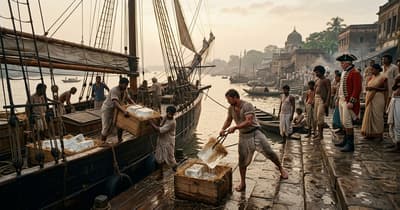
When the brig Tuscany reached Calcutta in September 1833, its strangest cargo was already supposed to be gone. Four months earlier, men in Boston had packed the ship with frozen pond water, sealed it under boards, bark, hay, and straw, and sent it toward India as if winter could be folded into a hold and sold in the tropics.
In 1833, Boston merchants sent about 180 tons of New England ice to Calcutta. After a four-month voyage, roughly 100 tons still reached shore, turning harvested winter into a luxury people had to learn how to protect.
In Calcutta, readers were handed instructions for keeping a clear lump alive after it left the ice house. The Mechanics' Magazine, reprinting a local account, called the ice a "precious luxury" and then began giving household advice. Keep it in a box, basket, or tin case. Wrap it in blankets. Pack it in chaff. Lay fragments over bottles if you wanted wine cooled, or drop a clear lump straight into the liquid.[1]
Between September 13 and 16, workers unloaded what remained of the frozen cargo from the Tuscany. About 180 tons had been stowed in Boston, packed so closely that the blocks were meant to behave like one mass, with tan bark below and hay above to slow the heat. After losses at sea, up the river, and during landing, about 100 tons went into a makeshift ice house at Brightman's Ghaut.[1]
After the ice reached private tables, dinner invitations became part of the experiment. Susan S. Bean, writing from Tudor's business papers and related records, notes the delighted social proof: "Everybody invited everybody to dinner to taste claret and beer cooled by the ice." That may be the best measure of the shipment. The miracle was not sitting in a warehouse. It was sweating on tables, changing the temperature of drinks before anyone fully trusted that it belonged there.[2][3]
A silver-gilt cup later turned up in a Cape Cod family's collection with the official thank-you engraved on it. Lord William Bentinck had presented it to William C. Rogers of Boston for the "spirit and enterprize" that brought the first cargo of American ice into Calcutta. Rogers had sailed with the ship. Frederic Tudor, Samuel Austin Jr., and Rogers had split the risk.[2]
In Tudor's diary, the fight against heat looks like carpentry, loading discipline, and irritation at meddlers. Sending ice to Calcutta, he wrote in 1833, had long been his wish. He also complained about other owners interfering with his loading plan, because the whole bet depended on small, unglamorous details: boards, straw, dry packing, and no careless pocket of air. Years of losses, warmer ports, better cutters, and sawdust packing had made the impossible seem merely difficult.[2]
On a Calcutta table, none of that labor would have looked like a business model. It would have looked like a fragment sliding over a bottle, or a clear lump dropped into wine while people watched to see how long New England could last in Bengal heat. A cold drink in Calcutta had become a chain of human faith: cutters on frozen ponds, sailors in a sealed hold, a partner crossing the ocean, readers wrapping boxes at home.
For a few minutes, a piece of Massachusetts winter could sit in an Indian glass, clear and temporary, making the distance between Boston and Calcutta sound like ice cracking under a spoon.