Thomas Drummond, a Scottish engineer, built a working limelight in 1826 after watching Michael Faraday demonstrate the underlying effect a year earlier [1]. The effect itself had been found in the 1820s by Goldsworthy Gurney, working with the oxy-hydrogen blowpipe, an instrument normally credited to the American chemist Robert Hare [1][3]. Drummond, a surveyor by training, saw that a small, very bright flame would suit the measurement of distances, and the device is still sometimes called the Drummond light after his adaptation [1].
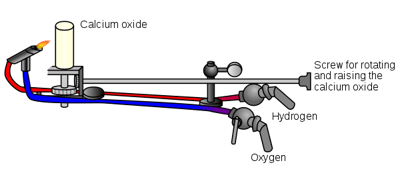
The flame at the centre of a limelight is oxyhydrogen, a mixture of hydrogen and oxygen that reaches about 2,800 °C at an exact stoichiometric ratio, roughly 700 °C hotter than a hydrogen flame in air [3]. That flame is aimed at a cylinder of quicklime, which is calcium oxide, a white alkaline solid made by heating limestone or seashells above 825 °C in a lime kiln [2]. Heated to about 2,400 °C, the cylinder gives off an intense glow [2]. Part of the light is ordinary incandescence and part is candoluminescence, in which a material in a flame emits more strongly at some wavelengths than a blackbody at the same temperature would [1][4].
The earliest known public use of limelight came outdoors, over Herne Bay Pier in Kent, on the night of 3 October 1836 [1]. It illuminated a juggling performance by the magician Ching Lau Lauro, staged as part of celebrations after the laying of the foundation stone of the Clock Tower. The playbill called the apparatus a koniaphostic light and announced that the whole pier was overwhelmed with a flood of beautiful white light [1].
Covent Garden Theatre in London put limelight to work indoors in 1837 [1]. The house had until then depended on candles: Restoration-era playhouses such as Covent Garden and Drury Lane were lit by a large central chandelier with smaller stage chandeliers and sconces around the walls, and dipped candles dripped hot grease on actors and audiences alike [5]. Limelight offered a directed, far brighter beam, and by the 1860s and 1870s it was in wide use in theatres around the world, picking out solo performers much as a modern spotlight does [1]. The heavily scenic staging that melodrama demanded gave theatres a further reason to adopt such technology [6].
Union forces used calcium lights, as the lamps were also called, during the siege of Fort Wagner in July and August 1863 [1]. The lights let artillery crews illuminate their targets at night while supposedly blinding Confederate gunners and riflemen, and the Union Navy fitted the lamps to its ships as well [1].
In Australia the technology arrived late in the 19th century, for theatres, public lectures and illustrated presentations [1]. The Salvation Army set up its Limelight Department in Melbourne in 1892, at first as a photographic and lantern-slide studio [1]. It grew into one of the world's earliest film production units, making hundreds of short films and pioneering multimedia presentations, among them Soldiers of the Cross in 1900, and recording the inauguration of the Australian Commonwealth in 1901 [1]. The department's output is regarded as foundational to the development of Australian cinema [1].
Electric arc lighting displaced limelight in the late 19th century, being both more efficient and safer [1]. Oxyhydrogen is explosive and can detonate when ignited, which made the lamps a hazard as well as a convenience [3]. The word outlived the hardware: the lamps themselves were called limes, a name carried over to their electrical successors, and a person in the public eye is still said to be in the limelight [1].