
Smalls Lighthouse stands on the largest of a cluster of basalt and dolerite rocks about 20 miles (32 km) west of the Marloes Peninsula in Pembrokeshire, Wales, and 8 miles west of Grassholm [1][4]. Trinity House, the general lighthouse authority for England, Wales, the Channel Islands and Gibraltar, counts it as the most remote light it operates [1][3]. The tower rises more than 40 metres above the rock [4]. The present structure dates from 1861, but the rock has carried a light since 1776 [1].
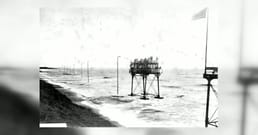
Liverpool merchant and shipowner John Phillips commissioned the first lighthouse, built between 1775 and 1776 to plans by Henry Whiteside, a Liverpool musical instrument maker [1][6]. Cast iron was soon abandoned for English oak, considered more elastic and trustworthy, and the light stood on nine oak pillars with the sea passing beneath [1]. It rocked in heavy weather but lasted 80 years [1][6]. In 1777 Whiteside was stranded there for a month by gales, and a message in a bottle he set adrift reached its addressee near St Davids two days later [1][6].
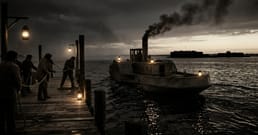
By 1801 the station was worked by two keepers, Thomas Howell and Thomas Griffith, who were known to quarrel [1][5]. Griffith died after a freak accident, and storms prevented Howell from alerting the authorities [1][4]. Howell feared that a lone man found at the post with a dead colleague would be accused of murder [1][5].
Howell kept the body inside the lighthouse until the smell became unbearable, then built a makeshift coffin and lashed it to a shelf outside [1][5]. Stiff winds broke the box apart [1][6]. One of Griffith's arms fell within sight of the hut window, and gusts caught it in a way that made it appear to beckon [1][6]. Passing ships saw the waving arm and had no reason to think the man it belonged to was dead [5].
Howell stayed on alone and kept the lamp lit [1]. That work meant trimming wicks, replenishing fuel and winding clockwork, the routine duties of a keeper in the oil-light era [2]. Relief reached him about three weeks after Griffith's death [4][5]. Friends who saw Howell afterwards did not recognise him, and one account says he never recovered his mental health [1][4].
After 1801, two-man postings gave way to rosters of three keepers, an arrangement that held until British lighthouses were automated in the 1980s [1][4][6].
In 1831 a wave tore up the floor of the keepers' room and slammed it against the ceiling, injuring every keeper and killing one [1]. Six years later the American captain Thomas Hubbard Sumner was approaching the Smalls in thick weather when he worked out the celestial position line, the principle behind most modern celestial navigation [1].
Trinity House bought out the private leaseholders in 1836, and the first stone of the replacement tower was laid on 26 June 1857 [1][3]. James Walker, engineer in chief, designed it, with James Douglass as chief engineer, and the tower was finished in 1861 [1][4]. A helideck was added above the lantern in 1978 and the light was automated in 1987 [1]. It was the first wind and solar powered lighthouse in the UK, and its 35 watt bulb, magnified by lenses, can be seen 21 miles away [1][6].