Imagine a sound so violent that it does not merely cross an ocean. It circles the planet. Then it does it again. And again.
That is what happened when Krakatoa erupted in August 1883. Not metaphorically. Not in the loose journalistic sense that “the whole world heard it.” The pressure wave from the eruption was tracked as it traveled around the Earth at least seven times.[1] The explosion was heard thousands of kilometres away, with reports from dozens of places across the globe.[1] Near the volcano, the noise was not just overwhelming. It was physically damaging.
It may be the closest recorded history has come to a sound that behaved like a planetary event.
The Morning The Island Blew Apart
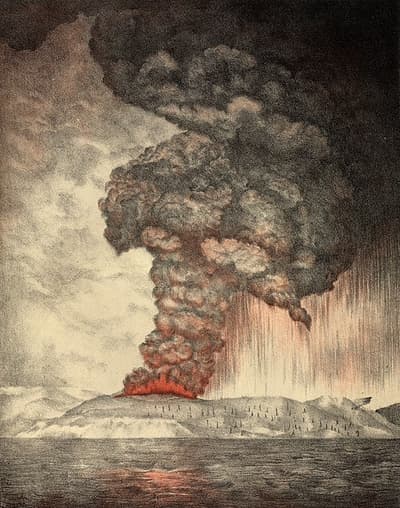
Krakatoa sat in the Sunda Strait, between Java and Sumatra, as part of a volcanic island group in what is now Indonesia. In May 1883 it began showing signs of unrest, but the catastrophe peaked over 26 and 27 August.[1] Then came the sequence that made the eruption legendary. On the morning of 27 August, four gigantic explosions tore through the island, the last and largest at 10:02 a.m.[1]
That final detonation was the one that entered history as a benchmark for sheer loudness. More than 70% of Krakatoa and the surrounding archipelago was destroyed as the volcano collapsed into a caldera.[1] This was not an eruption in the ordinary sense of ash and lava spilling from a mountain. It was geological demolition on a scale large enough to erase most of the island itself.
And it did not stop at destroying land. It sent enormous tsunamis outward, devastating nearby coastlines and killing tens of thousands of people.[1] The death toll long cited is 36,417, though some estimates run higher.[1]
The Sound That Damaged Bodies
We tend to think of sound as intangible. Annoying, maybe. Startling. But ultimately insubstantial. Krakatoa is a reminder that sound is pressure, and pressure at sufficient force becomes violence.
The eruption’s final blast has been estimated at around 310 decibels at the source, far beyond anything the human ear can safely process.[1] Sailors on ships relatively near the volcano reported ruptured eardrums.[1] This is the point where “loud” stops being the right word. A sound like that is no longer just heard. It injures.
Even far from the volcano, the blast remained astonishingly audible. It was heard in Perth, Western Australia, about 3,110 kilometres away, and on Rodrigues near Mauritius, roughly 4,800 kilometres away.[1] Contemporary reports claimed it was heard in around 50 different locations worldwide.[1] There are very few events in recorded history for which the phrase heard around the world can be used with almost embarrassing literalness. Krakatoa is one of them.
When The Atmosphere Became The Messenger
The reason the sound traveled so far is that Krakatoa was not merely making noise. It was striking the atmosphere hard enough to send a pressure wave racing through it.
Barographs around the world recorded the disturbance as it passed. Then they recorded it again. The airwave from the eruption circled the Earth multiple times, at least seven by some measurements, fading but still detectable as it kept going.[1] In effect, the planet rang.
This is one of the strangest things about the event. Usually, a sound begins dying the moment it is born. Krakatoa instead became a global atmospheric signal, a shock wave so strong that meteorological instruments on the far side of the world logged its passage. It is hard to think of a better example of the Earth behaving as a single connected system.
The Blast Did Not End When The Noise Did
Most disasters have the decency to stay local. Krakatoa did not.
The eruption blasted vast quantities of ash and sulfur dioxide high into the atmosphere, where they spread around the globe.[1] In the months and years that followed, people far from Indonesia saw extraordinary sunsets, strange twilights, and an altered sky.[1] The atmosphere scattered sunlight differently. For a while, the world looked bruised and theatrical.
Global temperatures also dropped in the aftermath, making Krakatoa one of the classic examples of a volcanic event that affected climate far beyond its immediate region.[1] That is part of why the eruption feels so modern in hindsight. It was not merely a local catastrophe. It was an environmental event with global fingerprints.
So the title’s claim that it darkened skies around the world is not really exaggeration. Krakatoa injected enough material into the upper atmosphere to make distant populations notice that the sky itself had changed.[1] The eruption ended in days. Its visual aftermath lingered for years.
Why Krakatoa Still Feels Unmatched
There have been larger eruptions in geological history. There have been deadlier disasters. But Krakatoa retains a special place because it collided so perfectly with human perception. It was an eruption people did not just suffer. They heard it, recorded it, watched it alter sunsets, and measured its pressure wave as it returned around the Earth.
That combination matters. A volcano can be unimaginably powerful and still feel remote. Krakatoa did the opposite. It made its force legible. It translated itself into sound, pressure, weather, death tolls, ruptured eardrums, and darkened skies. It left evidence in bodies and in instruments. It announced itself so loudly that even the atmosphere kept repeating the message.
Which is why the 1883 eruption still stands as the best candidate for the loudest sound in recorded history. Not because nobody has ever made a bigger claim, but because Krakatoa left behind one of the rarest things in disaster history: a superlative that can actually survive scrutiny.[1]