For most of her reign, Queen Elizabeth II seemed less like a person who would die than a permanent feature of the landscape, like Parliament, the Thames, or rain. Which is exactly why Britain spent decades preparing for the day she did.
The plan had a name that sounded almost gentle, almost bland: Operation London Bridge. But beneath that name sat an extraordinary machine, a funeral and succession blueprint refined over decades, revised several times a year, and built to choreograph the first minutes, hours, and days after the death of a monarch who had reigned since 1952.[1]
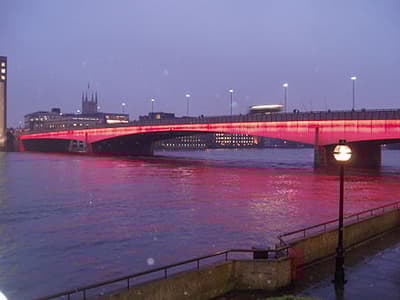
And at the centre of it all was a sentence so plain it almost feels fictional: “London Bridge is down.” That was the code phrase meant to tell the prime minister and senior officials that the Queen had died, and that the state should begin moving immediately into its next constitutional shape.[1]
The Phrase That Would Change the Country
Royal death plans in Britain have long used coded phrases. Partly this was about secrecy, partly about order. When George VI died in 1952, key officials were informed with the phrase “Hyde Park Corner.” Later plans for senior royals borrowed the names of famous bridges, creating a strange little geography of mortality: Tay Bridge, Forth Bridge, Menai Bridge, and, for Elizabeth II, London Bridge.[1]
The code mattered because the first moments after a monarch's death are politically delicate. A sovereign dies, but the Crown does not pause. There is grief, certainly, but there is also continuity. The message had to be short, unmistakable, and capable of setting many systems in motion at once, from government to media to transport to church ceremony.[1]
So the Queen's private secretary would contact the prime minister by secure line. Civil servants would pass along the phrase. The cabinet secretary and the Privy Council Office would be informed. From there, the news would radiate outward to ministers, senior officials, the governments of the other Commonwealth realms, and the wider Commonwealth itself.[1]
A Plan Built for a Queen Unlike Any Other
Operation London Bridge was not improvised in old age. Its roots went back to the 1960s, when officials first began seriously preparing for the eventual death of Elizabeth II. After that, the plan kept evolving, updated several times a year through meetings involving government departments, police, broadcasters, and other institutions that would have to perform under intense public attention.[1]
That list alone tells you what sort of event the Queen's death was expected to be. This was not just a family bereavement, nor even merely a state funeral. It was a national transition requiring coordination from the Church of England, the Metropolitan Police, the armed forces, the BBC, commercial radio, the Royal Parks, London boroughs, Transport for London, and central government itself.[1]
The Guardian described the preparations as “planned to the minute,” full of “arcane and highly specific” detail.[1] That feels exactly right. Monarchy depends on symbolism, and symbolism falls apart if the choreography slips.
What the Public Would See
Some parts of the plan were almost medieval in texture. A footman would pin a dark-edged notice to the gates of Buckingham Palace. Parliament would be recalled if needed. Flags would drop to half-mast. Gun salutes would fire. A remembrance service would be held at St Paul's Cathedral.[1]
Other parts were unmistakably modern. Government websites and social media accounts would go dark. Non-urgent official content would stop. The royal website would switch to a black mourning page carrying the announcement.[1]
The media had its own rehearsed ritual. PA Media and the BBC would be informed, while commercial radio stations would be alerted through a network of blue “obit lights,” signalling presenters to switch to restrained music and prepare for a news flash. BBC presenters even kept dark clothing ready so they could change immediately before the formal announcement. Newspapers and television networks had extensive prewritten coverage prepared in advance.[1]
All of this points to one strange truth: a national shock can be made less chaotic if enough people rehearse it in advance.
The Days After Death
The plan did not stop with the announcement. It mapped the country's emotional and ceremonial itinerary for the ten days that followed. The new monarch would meet the prime minister and then address the nation on the evening after the Queen's death. Books of condolence might open. Whitehall would enter mourning. London would begin reshaping itself around processions, crowds, and security.[1]
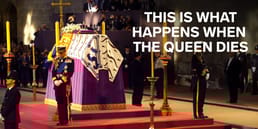
Then came the funeral architecture. Ten days after the Queen's death, a state funeral led by the Archbishop of Canterbury would take place at Westminster Abbey. At midday, a two-minute silence would be observed across the United Kingdom. Afterward, her body would be taken to Windsor and buried in the King George VI Memorial Chapel at St George's Chapel, alongside Prince Philip.[1]
Even that was only the visible layer. Supporting plans sat beneath London Bridge like scaffolding beneath a cathedral. Operation Marquee covered the ceremonial and vigil details of the lying-in-state. Operation Feather handled the logistics of the public queueing outside Westminster Hall. Other plans determined how the coffin would be transported depending on where the Queen died, whether at Windsor, Sandringham, overseas, or, crucially, in Scotland.[1]
Why Scotland Changed Everything
There was a reason another codename, Operation Unicorn, often appears beside London Bridge. If the Queen died in Scotland, as she ultimately did at Balmoral, the sequence had to change. Holyroodhouse, St Giles' Cathedral, and the Scottish Parliament would become focal points of mourning, and parliamentary business in Scotland would be suspended to make way for the national response.[1]
This is what makes Operation London Bridge so revealing. It was not simply a funeral checklist. It was a map of the United Kingdom's constitutional nerves. It anticipated geography, religion, media, transportation, public grief, and succession all at once. It treated the death of Elizabeth II not as a single event, but as a chain reaction.
The Meaning of the Plan
In one sense, Operation London Bridge was about death. In another, it was about continuity. Britain was preparing not just to mourn a queen, but to prove that even after the death of a monarch who had seemed almost permanent, the state could remain composed, ceremonial, and intact.
That is why the phrase “London Bridge is down” lingers in the imagination. It sounds like a line from a thriller, but it was really a key turning in a lock. One sentence, passed quietly along secure lines, meant that one era had ended and another had already begun.[1]