The final funeral papers for Winston Churchill eventually filled more than 415 pages, but one of the strangest edits was not a route, a hymn, or a gun salute. The plan had to keep making room for a stubborn fact of old age: Churchill was still alive, and some of the men expected to carry his coffin were not.[1]
Operation Hope Not was the code name for Winston Churchill’s state funeral plan, begun after his 1953 stroke and revised for years because, as Lord Mountbatten said, Churchill “kept living and the pallbearers kept dying.”
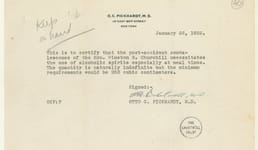
Churchill’s stroke came in 1953, during his second term as prime minister, and the episode was kept from the public.[1] Queen Elizabeth II was among the few who knew, and she authorized preparations for a funeral “on a scale befitting his position in history.”[1]
The code name carried a bleak little joke: Operation Hope Not.[1] In 1958, after Churchill nearly died from pneumonia, the planning became more urgent.[3] The Queen decided that Churchill, though not royal, should receive a full state funeral, a rare honor for a commoner and one compared in grandeur to the Duke of Wellington’s funeral in 1852.[1][3] Churchill’s daughter Mary Soames later said her father was gratified when the Queen indicated the honor to him years before he died.[3]
A Funeral Planned Before the Death
By 1957, Westminster Hall had been chosen as the place where Churchill would lie in state.[1] In 1958, a detailed plan was prepared under the Duke of Norfolk, the Earl Marshal, whose office handled the ceremonial machinery of such occasions.[1] The eventual title had the full weight of official Britain: State Funeral of the Late Sir Winston Leonard Spencer Churchill, K.G., O.M., C.H.[1]
Churchill then refused, by continuing to live, to match the timetable implied by all that paperwork. He survived the 1950s, entered the 1960s, and died at 90.[2] Mountbatten’s line about the pallbearers caught the absurdity perfectly.[1] A state funeral depends on names, ranks, positions, and bodies placed in exact order. Churchill’s longevity turned that precision into a recurring administrative problem.
On 24 January 1965, the plan finally stopped being hypothetical.[2] The final version was issued on 26 January, two days after Churchill’s death, and the funeral took place on 30 January.[1] By then, Operation Hope Not had existed for about twelve years.[1]
The Day the Plan Finally Worked
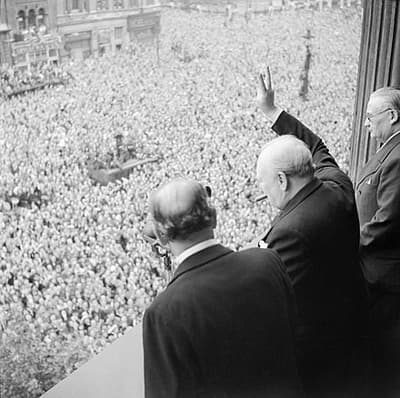
For three days, Churchill’s body lay in state in Westminster Hall by decree of the Queen.[2] On 30 January, the funeral service was held at St Paul’s Cathedral, with Queen Elizabeth II present, an unusual gesture at the funeral of a non-royal figure.[2] Representatives from 120 countries attended, and the ceremony involved thousands of participants, police, and security personnel.[2]
At Bethesda Naval Hospital in Maryland, President Lyndon B. Johnson was ill with a severe respiratory condition and still hoped to cross the Atlantic for the funeral.[3] His doctors and advisers opposed the trip, and former President Dwight D. Eisenhower attended instead as a guest of the Churchill family.[3]
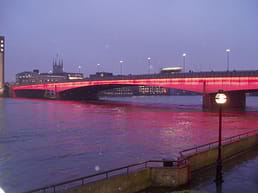
After St Paul’s, Churchill’s coffin was taken to the Thames and placed aboard the MV Havengore for the journey to Waterloo station.[1][2] From there, a funeral train carried him toward Bladon in Oxfordshire, where he was buried at St Martin’s Church near his father’s tomb.[1]
The surviving documents remain as a monument of another kind: hundreds of pages for a death that refused to arrive on schedule.[1] Operation Hope Not ended not with another revision, but with the coffin on the river, the train waiting at Waterloo, and the road to Bladon already cleared.