On Christmas Day in 1819, the old king would not stop talking.
For 58 hours, George III spoke in a torrent of nonsense, trapped inside a mind that had once carried an empire and could no longer reliably carry a sentence.[1][2] By then he was blind, increasingly deaf, crippled by rheumatism, and deep in the final collapse of the long illness that had haunted the last decades of his reign.[1][2] A little over a month later, he would be dead.
It is one of those royal endings so bleak it almost feels invented. But it happened to a man who had once been anything but a ruin.
Before He Became the “Mad King”
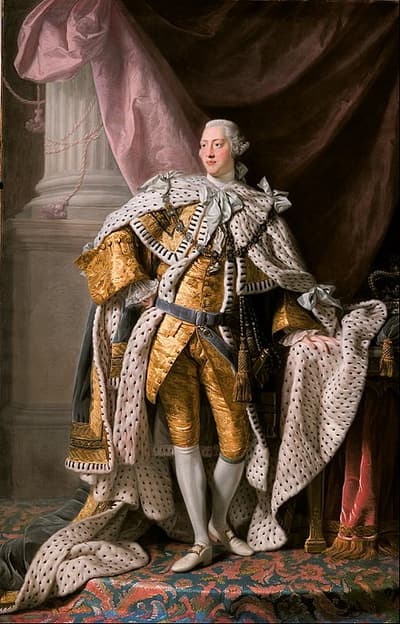
George III came to the throne in 1760 at the age of 22 and did not at first look like a monarch destined for tragedy. He was born in Britain, spoke English as his first language, took religion seriously, loved books, and cultivated an image of domestic steadiness unusual for a Hanoverian king.[1] He married Charlotte of Mecklenburg-Strelitz in 1761, remained faithful to her, and fathered 15 children.[1]
He was not a flamboyant king. That was part of the point. George presented himself as dutiful, restrained, sober, respectable. He studied science, took an interest in agriculture, and accumulated books with the zeal of a serious collector.[1] Later generations would nickname him “Farmer George,” sometimes mockingly, but the nickname captured something real. He preferred order to drama.
Which is what makes the drama of his collapse feel so jarring. George III did not begin as a caricature of royal instability. He began as a conscientious monarch whose life slowly became a medical mystery.
The Illness That Would Not Stay Gone
In the later part of his life, George suffered recurrent attacks of mental illness. Historians and doctors have argued ever since about what, exactly, was wrong with him. Some have suggested porphyria. Others believe his symptoms fit a psychiatric disorder more closely, including bipolar disorder or long-term psychosis.[1][2] The one thing nobody disputes is the scale of the damage.
During his episodes, he could become frenzied, voluble, disordered, and impossible to govern. He talked compulsively. He raged. He lost coherence.[2] At times he recovered enough to resume public life, which only made the pattern more unnerving. The illness did not move in a straight line. It advanced by ambush.
His first great collapse came in 1788, and it terrified the political nation.[1][2] Here was the king at the center of the British state, suddenly unable to perform kingship. Physicians bled him, purged him, sedated him, restrained him, and subjected him to treatments that now read less like medicine than panic dressed up as medicine.[2]
He improved, then declined again. And again. Each recovery bought time. None bought safety.
The Blow That Broke the Remaining Structure
By 1810, George was too unwell to rule, and his eldest son became Prince Regent in 1811.[1] The king who had reigned through the American Revolution, the French Revolutionary Wars, and the defeat of Napoleon was still alive, but politically absent. Britain entered the Regency not because the crown vanished, but because the mind wearing it had given way.
The final relapse came after the death of his youngest daughter, Princess Amelia, in 1810, a loss that appears to have shattered what remained of him.[1][2] After that, the descent looks less like a series of episodes than an occupation. In the years that followed, he became blind and increasingly deaf, suffered from painful rheumatism, and ceased even to recognise members of his own family.[1][2]
There is something especially cruel in that detail. George III had built much of his public identity around domestic virtue, family, fidelity, and moral seriousness. Then the illness took from him not only political command, but recognition itself.
Christmas at Windsor
By the end, he was living in deep isolation at Windsor Castle.[1][2] The king still understood, in some vestigial ceremonial sense, that he was the king. Even in disarray, he would pin the insignia of the Order of the Garter to his chest.[2] But the man inside the ritual was disappearing.
Then came Christmas 1819.
Accounts from the period describe a ghastly final scene: the old monarch in a shabby dressing gown, hair wild, beard untrimmed, talking continuously and senselessly for 58 hours before sinking into a coma.[1][2] It was not the theatrical madness of legend. It was something sadder than that. Exhaustion. Decay. The last mechanical firing of a mind that had long since been overrun.
Modern readers sometimes first meet George III through the cartoon outline, the “mad king” who lost America. But that label is too tidy for what actually happened. His illness was prolonged, humiliating, and almost certainly traumatic. It unfolded under public scrutiny, in an age with little understanding and less mercy. By the time he reached that final Christmas, there was scarcely any royal grandeur left to protect him from it.
Why the Story Lingers
The image endures because it compresses an entire reign into one terrible contradiction. George III had been one of the most durable monarchs in British history, reigning for nearly 60 years.[1] He had outlasted ministries, wars, revolutions, and enemies abroad. Yet in the end he could not outlast his own body, or whatever invisible force inside it kept returning to undo him.
He died on 29 January 1820 at Windsor Castle, aged 81.[1] The official cause was pneumonia.[1] But in another sense, his death had been arriving for years, through blindness, deafness, pain, confusion, and mental collapse.
That is why the 58 hours matter. Not because they are grotesque, though they are. And not simply because they are memorable. They matter because they turn George III from a distant textbook monarch into something more unsettlingly human: a once-powerful man trapped inside a failing mind, still speaking long after meaning had left him.