Molière was dying in costume. That is the image that outlived him. Not in bed, not at prayer, not in some stately final pose suited to literary legend, but onstage, in the middle of making other people laugh.
On February 17, 1673, he was performing in Le Malade imaginaire, the last play he had written, when he collapsed during the performance.[1] He recovered enough to continue. Then he collapsed again. A few hours later, he was dead.[1] It is one of those endings that feels too perfectly shaped to be true, which may be why it has endured. Molière, France’s great comic playwright, exits the world in a theater, still trying to finish the scene.
And yet what makes the story linger is not just its drama. It is the strange fit between the man and the manner of his death. He had spent his life turning hypocrisy, vanity, delusion, and human absurdity into performance. In the end, performance did not stop for his suffering. He kept going anyway.
The Man Behind the Stage Name
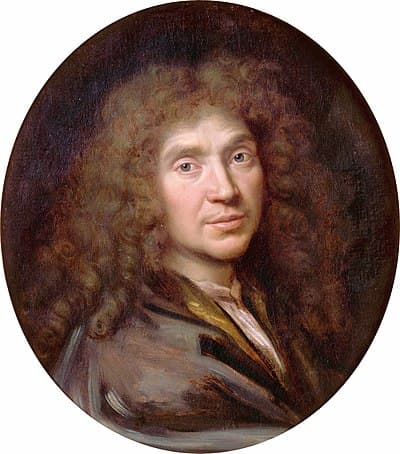
Molière was born Jean-Baptiste Poquelin in 1622 and would become one of the central figures of French literature, theater, and comedy.[1] As playwright, actor, and theater manager, he helped define what French comedy could do. His plays did not merely entertain. They observed. They exposed. They pricked at pretension with a kind of smiling ruthlessness.
That mattered because Molière wrote about human beings as they actually present themselves to the world: pompous, self-deluding, needy, theatrical in their own private ways. Hypochondriacs, misers, frauds, snobs, would-be saints, false intellectuals. He understood something basic and devastating, that ridicule is often more revealing than accusation.
His influence became so great that French itself would eventually be called “the language of Molière.”[1] That is not just literary praise. It is a kind of national absorption. Few writers become shorthand for the language they wrote in.
A Play About Imaginary Illness, Performed by a Very Sick Man
The final irony is almost too sharp. The play Molière was performing on the day of his collapse was Le Malade imaginaire, usually translated as The Imaginary Invalid.[1] It is a comedy about illness, or more precisely about the performance of illness, the vanity, fear, and self-importance that can gather around the body when a person becomes obsessed with being unwell.
But Molière himself was not imagining his condition. He was seriously ill, and modern accounts often connect his death to tuberculosis.[1] That gives the moment a brutal double image. Onstage, he was performing comic sickness. Offstage, his real body was failing.
This is part of what gives the episode its haunting force. Theater is built on the agreement that what happens in front of us is both true and not true. The actor suffers, but not really. The dying man gasps, but not really. The sick man is ridiculous, but not really. Until, suddenly, the boundary falters and the fiction and the body begin to overlap.
He Collapsed, Then Insisted on Finishing
Accounts of Molière’s last performance agree on the essential shape. During the fourth performance of Le Malade imaginaire, he suffered some kind of collapse or hemorrhagic episode onstage.[1] He nevertheless insisted on completing the performance.[1] This detail matters because it is the hinge on which the legend turns. Plenty of actors have fallen ill. Plenty of famous men have died dramatically. But to falter in front of an audience and still push through to the end, that is what turns biography into myth.
It also tells you something about the economics and psychology of seventeenth-century theater. A performance was not only art. It was obligation, livelihood, company discipline, public expectation. Molière was not just the star. He was the center of a troupe, the working manager of a theatrical enterprise. Stopping the show was not a purely personal decision.
And there is another possibility, simpler and more human. Perhaps he simply could not imagine not finishing. People often remain themselves at the edge of death. The dutiful become more dutiful. The stubborn become more stubborn. Molière, who had spent his life in theater, answered crisis with performance.
The Hours After the Curtain
After the play ended, he was taken home, where he died later that evening.[1] The closeness in time matters. He did not linger for weeks in some long literary decline. He passed almost directly from stage crisis into death. That makes the performance feel less like his final public appearance than like the opening act of his dying.
There is something cruel in that compression. He finishes the role. He leaves the theater. And then the body, held together just long enough to serve the form, gives way.
This is one reason the story became legendary so quickly. It feels symbolically overdetermined, as if the facts had been composed by a dramatist who knew exactly how to end the life of France’s great comic playwright. Of course, history rarely grants that kind of neatness. But sometimes it comes unnervingly close.
Even Death Did Not Spare Him Social Trouble
Molière’s death did not deliver him straight into uncomplicated honor. Actors in seventeenth-century France occupied a morally ambiguous place in religious culture, and burial could become contentious.[1] That, too, is revealing. Even for a writer of enormous fame, the social standing of the actor remained uncertain.
There is an almost Molièresque irony in this. A man who spent his career stripping pretension bare could not even die without running into another layer of institutional tension, this time over respectability, profession, and religious legitimacy. The comedies were over, but the hypocrisies remained right on cue.
Why This Death Endures
People remember Molière’s death not just because it was dramatic, but because it feels explanatory. It seems to tell us something essential about him, that he belonged so completely to the stage that he almost died within the logic of theater itself.
That is probably why the story survives even in simplified form. Ask people what they know about Molière, and many will mention two things: that he was one of the great comic playwrights, and that he died after collapsing while performing. The career compresses into the death because the death seems to summarize the career.
But the fuller truth is better than the shorthand. He was not merely a playwright felled by dramatic timing. He was a builder of French comedy, a master observer of social performance, and a man whose final hours became famous precisely because they looked like the last scene of a life already spent turning people into characters.
A Comic Playwright’s Final Seriousness
There is one last irony here. Molière is remembered as a maker of laughter, yet the story of his death is recalled with almost sacred gravity. No punchline survives it. No satirical twist dissolves it. What remains instead is the image of artistic duty carried to the edge of bodily collapse.
He wrote a play about imagined illness and performed it while mortally ill. He collapsed and continued. He collapsed again and died hours later.[1] It is the sort of ending that makes later generations feel that the theater is not merely a place where stories are told, but a place where a life can be consumed in public.
And perhaps that is the real reason the legend has lasted. It does not just tell us how Molière died. It tells us how completely he had already given himself to the stage before he did.