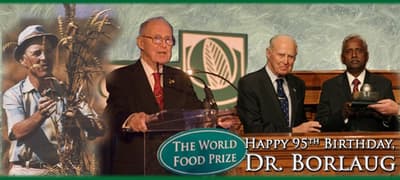
Norman Ernest Borlaug was born on March 25, 1914, on his grandparents' farm in Saude, near Cresco, Iowa [1]. He was the first of four children born to Henry Oliver and Clara Borlaug [1]. From age seven to nineteen he worked on the family's 106-acre farm west of Protivin, raising corn, oats, timothy grass, cattle, pigs, and chickens [1]. He attended the one-teacher New Oregon #8 rural school through eighth grade and then Cresco High School, where he wrestled and played football and baseball [1].
In 1933 Borlaug failed the University of Minnesota entrance exam and entered the school's new two-year General College [1]. After two quarters he transferred to the College of Agriculture's forestry program, earning a B.S. in forestry in 1937 [1]. He stayed at Minnesota for a PhD in plant pathology and genetics, completed in 1942 [1]. As a member of the university's wrestling team, he reached the Big Ten semifinals [1].
In Mexico, the Rockefeller Foundation funded an agricultural station to hybridize corn and wheat for arid climates and hired Borlaug to lead it [2]. Borlaug took an agricultural research position with CIMMYT and developed semi-dwarf, high-yield, disease-resistant wheat varieties [1]. Mexico became a net exporter of wheat by 1963 [1].
Wheat had been cultivated for roughly 10,000 years before Borlaug began his Mexican program, and domesticated strains depend on human sowing and harvesting because their seeds remain attached to the ear [3]. Early farming favored larger grains and non-shattering heads, traits that made harvest easier and left the crop unable to disperse without people [3]. Borlaug's semi-dwarf varieties added disease resistance and high yield to that long-established crop [1].
Between 1965 and 1970, wheat yields nearly doubled in Pakistan and India after Borlaug led the introduction of high-yielding varieties combined with modern agricultural production techniques [1]. The broader Green Revolution spread high-yielding cereal varieties, chemical fertilizers, pesticides, controlled irrigation, and mechanization [2]. Borlaug is often called the father of the Green Revolution [1][2].
The Norwegian Nobel Committee awarded Borlaug the 1970 Nobel Peace Prize for contributions to world peace through increasing food supply [1]. He also received the Presidential Medal of Freedom and the Congressional Gold Medal, making him one of only seven people to have received all three awards [1]. The 1970 award came after the yield gains in Pakistan and India [1].
A 1997 article by Gregg Easterbrook, "Forgotten Benefactor of Humanity," is the source of the estimate that Borlaug saved more than a billion people from starvation, according to Jan Douglas of the World Food Prize Foundation [1]. Dennis T. Avery also estimated that Borlaug's efforts saved one billion lives [1]. In 2009 Josette Sheeran, then executive director of the World Food Programme, said Borlaug "saved more lives than any man in human history" [1].
In his later years Borlaug helped apply methods of increasing food production in Asia and Africa [1]. He died on September 12, 2009 [1]. The yield gains in Mexico, Pakistan, and India are tied to his wheat varieties and Green Revolution practices [1][2].