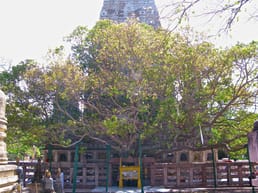
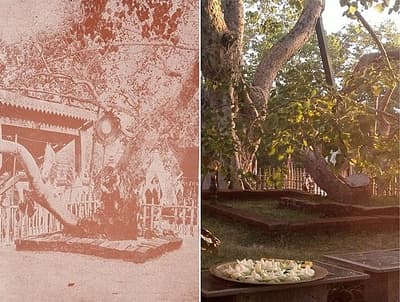
In the Mahamewna Gardens at Anuradhapura, Sri Lanka, the Jaya Sri Maha Bodhi stands on a terrace about 6.5 meters above the ground [2]. The tree is a Ficus religiosa, or Bo tree, in a city UNESCO lists as a World Heritage site [2]. Sri Lankan tradition identifies it as a growth from a cutting of the southern branch of the Bodhi tree at Bodh Gaya, where Siddhartha Gautama is believed to have attained enlightenment [2]. The site receives millions of pilgrims each year and is administered by the Chief High Priest of Atamasthana and the Atamasthana Palakasabha [2].
The Mahavamsa, the great chronicle of the Sinhalese, describes the establishment of the Jaya Sri Maha Bodhi and the site's development as a pilgrimage center [2]. Sri Lankan tradition connects the cutting with Sangamitta, a Buddhist nun and daughter of Emperor Ashoka, and with King Devanampiya Tissa, who planted it in his royal park at Anuradhapura [2]. The traditional planting date is 288 BC, and the site is described as more than 2,300 years old [2]. That documented planting event is the basis for calling it the oldest living human-planted tree with a known planting date [2].
King Vasabha, who reigned from 65 to 107 AD, placed four Buddha statues on four sides of the sacred tree [2]. King Voharika Tissa added metallic statues, King Mahanaga constructed a water canal, and King Sena II renovated the site [2]. The present wall was built by Ilupandeniye Athtadassi Thero during the reign of King Kirti Sri Rajasinha to protect the tree from wild elephants [2]. The wall is 10 feet high, 5 feet thick, 388 feet long from north to south, and 274 feet long from east to west [2].
Access to the uppermost terrace is restricted because of the tree's old age and a history of vandalism [2]. In 1985 an attack by the LTTE killed around 146 pilgrims at the site [2]. Four lower terraces hold Bo trees called Parivara Bodhi, planted for the protection of the main tree [2]. A golden fence was built around the sacred tree in 1969, with an iron fence below it added under the guidance of Yagirala Pannananda Thero [2].
Lists of oldest trees separate non-clonal individuals dated by tree-ring cross-referencing or radiocarbon from clonal colonies and trees with estimated ages [1]. The record holders for individual, non-clonal trees are Great Basin bristlecone pines in California and Nevada, which tree-ring cross-referencing has shown to be almost five thousand years old [1]. A quaking aspen colony nicknamed Pando in Utah has recent age estimates of about 16,000 to 37,000 years, although individual stems rarely exceed 130 years [1]. The Jaya Sri Maha Bodhi belongs to a different category because its claim rests on a recorded planting date rather than a tree-ring count or growth-rate estimate [1][2].
A clonal colony can outlive any single trunk, and the list of longest-living organisms notes that this complicates the meaning of longest-living [3]. That list explains that lifespan estimates depend on whether dormant periods count and on how an individual organism is defined [3]. The Jaya Sri Maha Bodhi is a single planted tree with a historical date, so its age claim does not depend on genetic identity across a colony or on present-day growth rates [2][3].
Superlative tree records include height, girth, canopy coverage, wood volume, mass, and age, and historical measurements of tree height have often been unreliable [4]. Modern laser rangefinders and tape-drop measurements have shown that older methods could exaggerate height by 5 percent to 15 percent or more [4]. The Jaya Sri Maha Bodhi's distinction rests on a documented planting event, not on a disputed measurement of height or girth [2][4]. Its protected terrace and surrounding Bo trees have changed over centuries, while the recorded date remains central to its place in tree records [2].