You can point to red in a rainbow. You can point to orange, yellow, green, blue. Those colors have addresses. Each corresponds to a particular range of wavelengths of light.
Purple does not.
That is the strange thing about one of the most vivid colors humans experience. Purple feels as real as any other color. It can dominate a painting, a flower, a bruise, a sunset. And yet there is no single wavelength of light that is “purple” in the way a single wavelength can be red or green or blue. Purple is what your brain constructs when it is pushed into an unusual corner of color perception.[1]
In that sense, purple is less like a destination on the visible spectrum and more like a shortcut your visual system invented.
The Colors That Exist Out There, and the Color That Exists In Here
Human color vision begins with something deceptively simple. The eye can distinguish color in terms of hue, saturation, and brightness.[1] When the light entering your eye is a single wavelength, the story is relatively straightforward. Spectral colors, the colors spread out in a rainbow, can be mapped directly to wavelengths of light.[1]
That is the comfortable version of color. Light comes in, wavelength goes to the brain, color comes out.
But most of the colors humans actually see are not that simple. The moment multiple wavelengths are mixed together, perception becomes much stranger. Different combinations of wavelengths can produce the exact same perceived color.[1] In other words, your brain is not reading a neat label from nature. It is making a judgment.
That judgment is why purple is possible.
The Rainbow Has No Purple In It
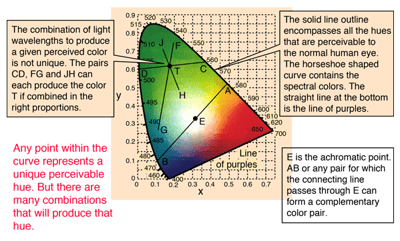
If you look at a chromaticity diagram, the pure spectral colors trace the outer curved edge, the path of colors that can be produced by single wavelengths of light.[1] Then something odd happens. The bottom edge is not part of the spectrum at all. It is what physicists call the “line of purples.”[1]
That phrase sounds poetic, but it is really a technical confession. The line of purples represents colors that cannot be produced by any single wavelength of light.[1] They are fully vivid colors, fully saturated in perceptual terms, but they do not correspond to any one place in the rainbow. To get them, you need a mixture.
That is the key distinction. Violet exists as a spectral color. Purple does not. Violet can be found at the short-wavelength end of visible light. Purple is what happens when the brain is presented with strong red and strong blue input without the green that would normally connect them through the middle of the spectrum.
Your Brain Hates A Gap, So It Fills One In
This is where color stops being merely physics and becomes neuroscience.
Your visual system is built around three kinds of cone responses, often simplified as red, green, and blue sensitivities. Modern color measurement expresses this kind of perception through tristimulus systems, because any color that can be produced from primaries can be described by the relative intensities of three components.[1] That is already a clue that color is not simply a one-wavelength, one-color story. It is a comparison problem.
When your eye receives strong stimulation from the long-wavelength end of the spectrum and the short-wavelength end at the same time, but little to no stimulation from the middle, your brain is put in an awkward position. Red and blue are both “on.” Green is not. There is no single spectral color sitting between those extremes that matches that pattern, because the spectrum runs through greenish territory on the way from one end to the other.
So the brain does what brains do best. It invents a coherent percept.
That percept is purple.
Why This Is Not Just A Trivia Quirk
It is tempting to treat this as a cute fact, purple is imaginary, moving on. But it actually reveals something deep about vision. Color is not a property of the world in the simple way we often pretend it is. Light has wavelengths. The brain has interpretations. Those are related, but they are not identical.
HyperPhysics makes this clear in a broader way: many different mixtures of wavelengths can create the same color experience, and even two light sources that look equally white can be composed of very different wavelength mixtures.[1] Shine those two “white” lights on an object that selectively absorbs some wavelengths, and that object may look very different under each one.[1]
That means color is never just “there.” It is always a negotiation among incoming light, the spectral sensitivities of the eye, and the brain’s way of collapsing all that information into something usable.
Purple just happens to be one of the clearest demonstrations of that negotiation.
A Color With No Wavelength And Plenty Of Reality
Calling purple a non-spectral color can make it sound less real, as if it were a mistake or an illusion. But that is the wrong lesson. Purple is not fake. It is perceptual. And in vision science, that is not a downgrade. It is the whole story.
After all, every color you experience is, in the end, an experience. The world sends light. Your nervous system turns that light into meaning. Purple simply exposes the machinery more clearly than most colors do. It reminds you that seeing is not passive reception. It is active construction.
That is why purple feels so satisfying as both a color and an idea. It sits outside the spectrum but not outside perception. It does not exist as a single wavelength in the world, yet it exists vividly and unmistakably in the mind. The rainbow cannot hand it to you directly. Your brain has to finish the job.[1]