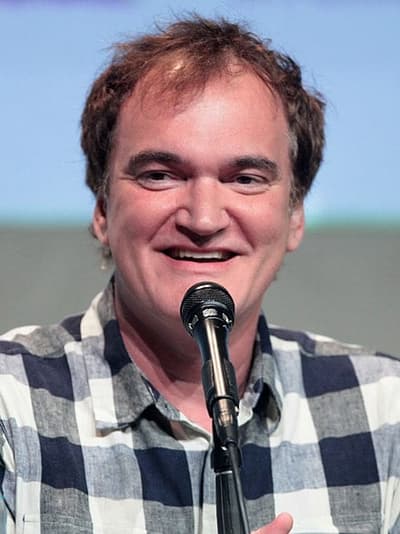
Before Quentin Tarantino became Quentin Tarantino, he was doing the kind of work ambitious filmmakers do before the real career arrives. Odd jobs. Small acting parts. Anything that paid. And in 1988, one of those jobs was gloriously specific: he played an Elvis impersonator on The Golden Girls.[1]
It is one of those details that sounds too perfect to be true. The future director of Pulp Fiction and Reservoir Dogs, a man who would become synonymous with cool, violence, and pop-culture quotation, once showed up in a sitcom wedding episode dressed as Elvis. Not as a joke in retrospect, but because that was the work available to a struggling filmmaker trying to stay afloat in Hollywood.
And the money mattered. Tarantino later said the pay from that appearance helped support him during the preproduction of Reservoir Dogs.[1] He recalled being paid about $650 up front, then earning roughly $3,000 more in residuals over the next three years because the episode kept being rerun, especially as part of a “best of” lineup.[1] In other words, that one odd little TV role ultimately brought in about $3,650, enough to matter when your first film still exists mostly as nerve, paper, and hope.
The Elvis Cameo Before the Breakthrough
The episode was “Sophia's Wedding: Part 1,” from the fourth season of The Golden Girls, first broadcast on 19 November 1988.[1] Tarantino appeared as an Elvis impersonator, one of several Elvises hired for the wedding setup. At the time, nobody watching had any reason to think the guy in sideburns and costume would soon help reshape American independent film.
That is what makes the story so satisfying. It captures Tarantino at the exact moment before the mythology hardens. Before the awards, before the headlines, before people started speaking of him as the defining director of a generation, he was one more young Hollywood striver collecting a television paycheck.[1]
And he needed it. The Tarantino of the 1980s was not yet a director with studio backing. He was a film-obsessed dropout who worked a string of jobs, including as an usher at an adult movie theater, a recruiter in the aerospace industry, and, most famously, a clerk at Video Archives in Manhattan Beach, where his encyclopedic knowledge of movies became part of his local legend.[1] He liked to say that when people asked whether he went to film school, he answered, “No, I went to films.”[1]
The Years Before Reservoir Dogs
Those years mattered because Tarantino was not waiting passively for discovery. He was writing. In his teens he had already written an early screenplay. In the 1980s he co-wrote, directed, and acted in unfinished or little-seen projects, including My Best Friend's Birthday.[1] He also took acting classes, where he met future collaborators, and kept circling closer to the kind of work he actually wanted to make.[1]
By the late 1980s, he had the sensibility, the references, and the voice. What he did not yet have was the infrastructure. That is the part people often edit out of origin stories. Great careers are not built only from talent. They are built from rent money, timing, lucky breaks, and the strange little income streams that let somebody keep going six months longer.
Tarantino's Elvis paycheck was one of those streams. Not enough to fund a movie on its own, of course, but enough to help him stay afloat while Reservoir Dogs was still trying to become real. And Reservoir Dogs did not emerge from a studio assembly line. Tarantino wrote the script in roughly three and a half weeks after producer Lawrence Bender encouraged him to turn an unwritten heist idea into an actual screenplay.[1] Bender then helped pass it through contacts to director Monte Hellman, and Harvey Keitel eventually came aboard, acting in the film and helping secure the budget as a co-producer.[1]
That chain of events is worth lingering on. A video-store clerk writes a script. A producer likes it. A veteran actor signs on. Financing becomes possible. A low-budget crime film goes to Sundance in January 1992 and lands with the force of something new.[1] That is the version we usually remember. But before Sundance, before Keitel, before the critical response, there was still the matter of getting through the week.
Why This Tiny Detail Feels So Big
The Elvis role matters because it compresses the whole pre-fame Tarantino story into one image. On one side, there is the future auteur, already loaded with film knowledge, already writing his way toward a breakthrough. On the other, there is the working actor in a sitcom cameo, cashing a modest check and then quietly benefiting when reruns keep coming.
It also says something important about how independent film actually gets made. Not through purity. Not through romantic suffering alone. Through accumulation. Through scraps. Through side gigs that look irrelevant until, later, they turn out to have financed just enough of the next step.
And maybe that is the real charm here. Reservoir Dogs now sits at the beginning of one of the most recognizable directing careers in modern cinema.[1] But part of the money that helped Tarantino survive its preproduction came from playing fake Elvis on The Golden Girls. Hollywood loves grand myths. This one is better because it is so small, so practical, and so weirdly perfect.