It’s a long-standing tradition for fans to paint their favorite riders’ names on the road. The Tour de France is the most popular platform for this type of fandom. There are also more, shall we say, creative artists who want their work to be seen by the largest television audiences in professional bike racing. But did you know how Tour de France clears out obscene graffiti?
The Tour de France has a dedicated support team that travels ahead of the stage and covers genital graffiti.
Clearing the Big D on the Road
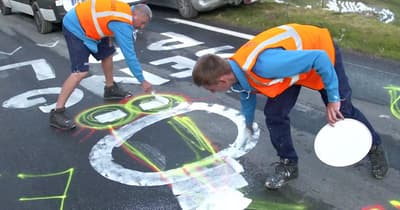
The race organizer Amateur Sports Organization employs a crew of workers who drive the route ahead of the peloton with a bucket of paint every day. Their mission is to creatively alter some of the images painted on the road that ASO would prefer not be seen by TV viewers. Male genitals are among the photos that need to be changed the most. The true artists are the workers who conceal their genitals.
Cleaning the road surface of these images would be too time-consuming and costly, so workers instead apply paint, transforming genitals into owls, butterflies, and other imaginative imagery. The effort is made so spectators and television viewers do not notice the original images. In a video, the Dutch news agency NOS followed two workers as they worked on the Tourmalet, one of the most famous climbs featured in this year’s Tour de France. (Source: Cicerone)
The First Tour De France
In 1903, the first Tour de France, the world’s greatest bicycle race, took place. The first event was a six-stage race covering 2428km, created by Henri Desgrange, the editor of L’Auto, and George Lefèvre, the rugby and cycling reporter, to help publicize and improve the circulation of this sports newspaper.
The cyclists cycled from Paris to Lyon, then to Marseille, Toulouse, Bordeaux, Nantes, and finally back to Paris. The average stage distance was 405 kilometers, meaning competitors had to cycle at night and during the day! They were also required to perform their repairs if necessary. (Source: Cicerone)
The Iconic Yellow
Desgrange introduced the yellow jersey shortly after World War I. He chose yellow for two reasons: roadside spectators could quickly identify the race leader, and, perhaps more importantly, L’Auto was printed on yellow paper.
18 июля 1919 года Южен Кристоф стал первым человеком, который надел желтую майку. Оттавио Боттечча стал первым итальянцем, выигравшим Тур, который ранее доминировали французы и бельгийцы.
Самая длинная гонка в истории Тура, охватывающая общую дистанцию 5745 км, состоялась в 1926 году. К началу 1930‑х, когда Тур открылся для других рекламодателей, трансляция шла в прямом эфире по радио, и французские гонщики выигрывали гонку шесть лет подряд; такие монстрские заезды стали прошлым. Переключатели скоростей впервые были разрешены в Тур де Франс в 1937 году.
Джино Бартали, итальянский велосипедист, выиграл Тур год спустя, а затем снова через десять лет, в 1948 году, в возрасте 34 лет. На Туре 1950 года Бартали был физически атакован на Col d’Aspin. Тем не менее, он выиграл этап, после чего он и его итальянские товарищи по команде, включая победителя 1949 года Фаусто Коппи, вышли из гонки в знак протеста. (Source: Cicerone)