
A tiger cannot purr. Instead of the rolling rumble a domestic cat makes, a content tiger narrows its eyes or closes them completely [2]. The gesture is small and easy to miss, and it carries much of the meaning that a purr carries in a house cat. Nothing about it is loud or obvious.
A tiger is a felid, and its domesticated cousins purr, so the leap from one to the other looks short [1][2]. The leap fails. A tiger's contentment shows in its face instead [2].
The eyelids drop, the eyes narrow to slits, and some tigers shut them entirely [1][3]. Accounts of the behavior describe the same sequence, and the movement is purposeful rather than reflexive [1]. It appears in animals that have settled rather than animals that have been startled [1].
Closing the eyes costs a tiger its guard. Losing vision lowers the animal's defenses, so a tiger does it only when it feels comfortable and safe [1][2][3]. The tiger is trading awareness for a signal, and the signal only works because the cost is real. When one tiger shuts its eyes in front of another, the message is that it can relax in that company [2].
Tiger eyes are built for dim light. Their night vision is roughly six times better than a human's, and their round pupils suit an animal that hunts mainly in the morning and evening [4]. That eyesight is worth a great deal to a hunter that works alone. Dropping the lids gives up real information, which is why the squint reads as confidence rather than habit.
Tigers prefer to hunt by ambush, and eye contact spoils an ambush [5]. A person who meets a tiger's gaze has shown the animal that it is no longer hidden, and the tiger will most likely go looking for something else to eat [5]. By the same measure, a tiger with its eyes shut has set aside the advantage it normally keeps. The closed eye is a statement about the next few seconds, and the statement is that nothing here needs watching.
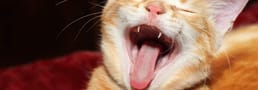
Domestic cats run the same program. Many cats squint or close their eyes when they are comfortable, and a slow blink aimed at a cat will often draw a slow blink back [1][3]. The behavior belongs to the wider cat family rather than to tigers alone [3]. Anyone who has tried the slow blink on a household pet has tested the same signal at close range.
Tigers are solitary and territorial, and they defend their ranges against other tigers [3]. An animal that lives that way has few chances to send a signal of trust, so the squint is saved for company it has already accepted [1][2]. That leaves tigers with a narrow vocabulary for contentment: no purr, no rumble, just a slow narrowing of the eyes, held for a moment and then released [1][2][3].