There is a strange kind of compliment you can pay a general. You can say he is brave. You can say he is ruthless. You can say he wins. But the highest compliment, and perhaps the most unnerving, is this: entire nations redesign their war plans around the idea of not fighting him directly.
That is what happened with Napoleon in 1813.
By then Europe had spent years learning the same lesson the hard way. Meet Napoleon on a battlefield of his choosing, and things had a habit of going badly. Not always. But often enough, and spectacularly enough, that by the time the Allies met at Trachenberg during the German Campaign of 1813, they arrived at an extraordinary conclusion. If they wanted to defeat Napoleon, they should avoid Napoleon.[1]
Not France. Not the French army as a whole. Napoleon himself.
The Problem Was Not Just the Army, but the Man
The Trachenberg Plan, named for the conference at Trachenberg Palace, was a coalition strategy developed during the War of the Sixth Coalition.[1] Its logic was simple, cold, and remarkably revealing. The Allies would avoid direct battle with Napoleon whenever possible. Instead, they would attack his marshals and generals when they were separated from him, wear down French strength piecemeal, and keep doing so until they had assembled a force so large that even Napoleon could not defeat it.[1]
That distinction matters. The plan did not say, “Avoid the French because the French are too strong.” It said, in effect, “Avoid Napoleon because Napoleon is the dangerous part.”
That is not mythology speaking after the fact. That is strategy written by the people trying to destroy his empire in real time.
A Coalition Built from Prior Humiliations
The Allies did not arrive at this idea out of admiration alone. They arrived at it through repeated punishment. The road to Trachenberg was paved with defeats, close calls, and the accumulating realization that Napoleon still had a nearly unmatched ability to snatch order from chaos and turn a battle in his favor.[1]
This was especially alarming in 1813 because Napoleon was no longer operating under ideal conditions. His empire had been damaged. His armies had been strained. The catastrophe in Russia lay just behind him. And yet he remained dangerous enough that the safer strategic choice was still to step away whenever he appeared in person.
That tells you something important about military reputation. Some reputations are inflated by memoirs. Napoleon’s was feared by professionals who had every incentive to judge him soberly.
The Core Idea: Retreat from Napoleon, Crush Everyone Else
The Trachenberg Plan is sometimes summarized so neatly that it can sound almost obvious: if Napoleon is present, retreat; if his subordinates are present, attack.[1] But that neatness hides how radical the idea really was.
Coalitions are usually fragile. They are made up of governments with different interests, different armies, different commanders, different egos. What Trachenberg offered was a disciplined way to stop those differences from being exploited by Napoleon’s greatest talent, his ability to destroy enemies separately before they could fully combine.
So the Allies reversed the logic. They would be the ones doing the separating. They would deny Napoleon the decisive battle he wanted, while seeking out French forces that lacked his personal direction. His marshals and generals, formidable though many of them were, were not him. And in war, “not Napoleon” was becoming its own exploitable category.
Why This Was So Hard to Do
The plan sounds elegant on paper. In practice, it demanded unusual restraint. Armies are not naturally built for strategic humility. Commanders want victories they can see. Politicians want advances on maps. Soldiers do not love being told that the correct response to the enemy’s appearance is to back away.
But that was precisely the discipline the plan required. If Napoleon took the field, coalition armies were to refuse him the climactic confrontation that had so often allowed him to impose his will.[1] That meant enduring the optics of retreat in order to gain the reality of advantage later.
In other words, the Allies had to accept a short-term humiliation to avoid a long-term disaster. They had to look beaten without actually being beaten. That is psychologically difficult, which is one reason such plans are easier to write than to obey.
The Bernadotte Irony
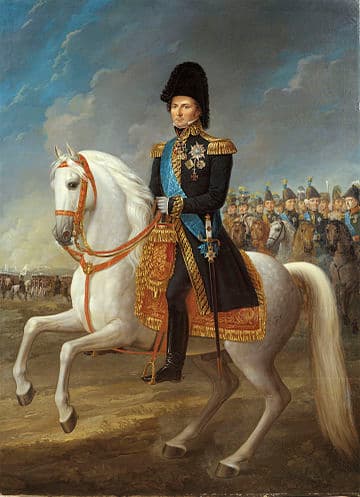
One of the figures associated with the Trachenberg Plan was Jean-Baptiste Bernadotte, the former Marshal of the Empire who had become Crown Prince Charles John of Sweden.[1] There is something almost novelistic about that detail. One of Napoleon’s old marshals was now helping design the method by which Europe would contain Napoleon himself.
And perhaps that makes sense. Who would better understand the asymmetry than someone who had seen the Napoleonic system from the inside? The emperor’s lieutenants could be dangerous, certainly. But the emperor’s presence altered the arithmetic. He was not just another commander in the French hierarchy. He was the force multiplier around which the entire machine changed character.
The Plan Worked Because It Treated Genius as a Strategic Variable
Most military planning deals in ordinary categories: troop strength, supply, position, speed, weather. The Trachenberg Plan had to add something less comfortable, the individual talent of one man.[1]
This is what makes it so fascinating. It was not merely a plan for defeating France. It was a plan for reducing the battlefield value of Napoleon’s personal genius. If he excelled at decisive battle, avoid decisive battle. If he excelled at concentrating force, deny him targets worth concentrating on. If he could rescue situations his marshals could not, then fight the marshals before he could arrive.
That is a very modern-seeming insight hidden inside an early nineteenth-century campaign. The Allies were not pretending all enemy commanders were interchangeable. They were planning around the fact that they were not.
What It Says About Napoleon
It is tempting to tell Napoleonic history as a string of dramatic battles, one dazzling tactical performance after another. The Trachenberg Plan points to something deeper. Napoleon’s military prestige had become so immense that it reshaped enemy behavior before battle even began.
That may be the truest measure of his power. Not merely that he could win battles, but that he could alter the strategic imagination of Europe. He forced coalitions to think in terms of avoidance, delay, and accumulation. He made caution rational.
And yet there is a paradox here. The very scale of that fear also reveals how he could be beaten. If you cannot safely defeat the man at the center, then remove the conditions that let the center matter. Drain strength from the edges. Attack the lieutenants. Refuse the masterpiece. Build numbers. Wait.
The Genius Trap
In that sense, the Trachenberg Plan was not simply an admission of Napoleon’s greatness. It was an attempt to turn that greatness into a limitation. A commander who thrives on decisive engagement can be denied decisive engagement. A battlefield genius can be forced into a campaign whose terms are cumulative, evasive, and impersonal.
This is one of history’s recurring patterns. Extraordinary talent often creates extraordinary countermeasures. The more dangerous the individual, the more impersonal the response becomes. Napoleon inspired not just resistance, but systematized resistance.
So when the Sixth Coalition finally adopted the strategy of retreating from Napoleon while striking at his subordinates, it was doing something subtler than merely avoiding a hard fight. It was acknowledging that the straight line toward victory had already failed too many times. The only remaining path was the indirect one.[1]
Why the Story Endures
The Trachenberg Plan endures because it captures a rare and revealing moment in military history, a moment when an alliance effectively said: we cannot fight this man the normal way, so we must redesign normal.
That is an astonishing thing for enemies to admit, even implicitly. It tells us that Napoleon’s genius was not some later romantic embellishment. It was operational reality, real enough that seasoned opponents made “avoid him whenever possible” a central principle of coalition warfare.[1]
And that, in the end, may be the sharpest way to understand the plan. It was not just a strategy for defeating Napoleon. It was a strategy written in the shadow of the fact that, face him directly too often, and he was likely to defeat you first.