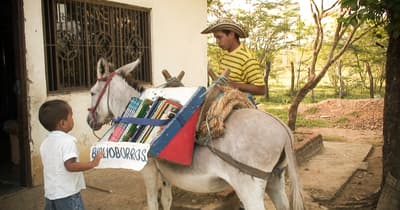
When Luis Soriano decided to bring books to children in rural Colombia, he adapted equipment he already had: the packsaddles on his two water-carrying donkeys. His students had no books at home, and he wanted them to have something to read. With the packs altered to hold books, Alfa and Beto could carry a traveling library out into the countryside, accompanied by the teacher who had filled it.[1]
Soriano taught Spanish in La Gloria and began the collection with 70 of his own books. He later dated the project to 1997, describing communities where children lacked schools and teachers and often worked instead of going to class. Getting books to them meant taking on the journey himself, with two animals whose transport arrangements gave the library its name: Biblioburro.[1][2][3]
At three in the morning, Soriano would begin choosing books for a typical day's trip, he told Princeton's Cotsen Children's Library in 2015. The day's work included traveling, gathering the children and helping them learn to read, before he returned home ahead of five in the afternoon. The children were borrowing from a collection that had to be selected, loaded and brought to them before the reading could begin.[3]
On the weekend rounds recorded in Carlos Rendón Zipagauta's documentary, the donkeys took trails that could be nearly impassable, with swollen streams among the obstacles. Armed groups and bandits added dangers of their own. Some children also traveled long distances to meet Soriano, who read to them and instructed them in looking after their borrowed books. He invited them to tell stories and draw pictures of their lives, giving them room to describe experiences of violence as well as listen to someone else's story.[2]
Back at the house Soriano shared with his wife, Diana, and their three children, donations were making the library harder to contain. A report accompanying the film's American broadcast in 2011 described 4,800 books piled to the ceilings, while a separate library was still partly built. Diana and the children helped catalogue and store the collection, and she opened a small restaurant to help meet the family's expenses. Before a child could borrow a donated book, someone in that crowded household had work to do.[2]
By the 2015 interview, Soriano counted 6,000 books, including novels and fables alongside dictionaries and encyclopedias. Asked which were most popular, he mentioned children's stories and the reference works readers used to look things up. He was also finding ways to bring computer-based learning into the program, while keeping books central to it.[3]
For movie days called Countryside Movies, the children could gather to watch a film together. Soriano said the program had five computers and a projector, and spoke fondly of those shared screenings. Then, in the same interview, he returned to the equipment: they urgently needed a television for the library and a new projector.[3]
Sources
- BBC Culture: Biblioburro
- Latino Public Broadcasting: The Donkey Library
- Princeton Cotsen Children's Library: Interview With Luis Soriano
Image: Acción Visual/Diana Arias, Wikimedia Commons, CC BY-SA 3.0. Cropped and color-converted; this image adaptation is also CC BY-SA 3.0.