In Marton-cum-Grafton, North Yorkshire, residents paid £1 for a disused red telephone box and asked local children to help fill it with books. The purchase came with a question a pound could not settle: would anybody keep bringing books? The village gave its new library a three-month trial.[1]
BT began letting communities adopt redundant phone boxes for £1 in 2008. Villages and neighbourhood groups turned them into miniature libraries, art galleries and defibrillator stations, keeping the familiar red boxes in use after the phones were no longer needed.[2]
When the York Press reported on the Marton-cum-Grafton experiment in 2010, the shelves held only a small collection. Council clerk Linda Bullus hoped people would drop off more books as they borrowed others. There was no guarantee that a book going out would bring another one in. For now, the council had a little stock, willing children and a trial period.[1]
Under the adoption scheme, councils and charities could take responsibility for a box that BT no longer needed as a payphone. The company favoured organisations over individuals to give the arrangement some continuity. The pound bought the kiosk; fresh paint and people willing to look after it would have to follow. The modest purchase price left plenty of work for the new owners.[2]
By 2022, more than 7,000 kiosks had been adopted, according to the Guardian. Some held plants, some displayed art, and many housed defibrillators. Across those conversions, people kept finding reasons to open the same heavy door. A box could stay in place while the errand that brought someone to it changed completely.[3]
In Borrowdale, in the Lake District, residents had a reason to resist the offer. BT suggested using their boxes for flowers or books, but they still needed the telephones. Local resident Freda Chapman told the Guardian that adoption was a nice idea if a village no longer needed its phone. Her community wanted to keep making calls. The books would have been welcome somewhere else.[3]
In Lewisham, south London, artist Sebastian Handley started a phone-box library that opened in 2013. By the time a Guardian reporter visited in 2019, Handley had moved away. The Brockley Society had adopted the kiosk, and Susan Bennett and Tom Simpson were looking after it. The founder could leave without taking the library with him.[2]
On its seven shelves, the reporter found novels by Orhan Pamuk and Henning Mankell, an old book of English poetry, and a film-festival catalogue in Czech and English. That was the range a book exchange could acquire without a buyer ordering its stock. A visitor looking for a novel might leave knowing that a Czech queer film festival existed.[2]
By the time Bennett spoke to the reporter, visitors were doing some of the looking-after themselves. They brought books, took others away and straightened the seven shelves. She described the library as largely self-managing. Handley had moved on; people he no longer lived among were still opening the door and tidying up.[2]
Sources
- York Press: Marton-cum-Grafton phone-box library
- The Guardian: Britain's red phone boxes find new uses (2019)
- The Guardian: The last phone boxes (2022)
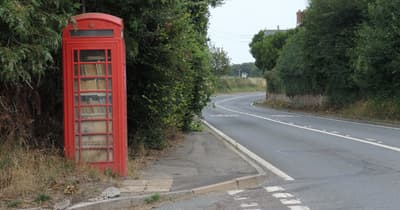
Hero: Phone-box library in Watergore, photographed by Neil Owen, via Geograph / Wikimedia Commons. Cropped and resized under CC BY-SA 2.0. The photograph shows a separate example of a converted kiosk.