In Leh, high in the Indian Himalaya, one co-working retreat made a quiet rule for its servers: no spinning hard drives. The town sits around 11,482 feet above sea level, high enough that the problem is not the view, the cold, or even the internet. It is the thin air inside an ordinary hard drive.[3]
Ordinary consumer hard drives depend on air pressure to keep the read/write head floating just above the spinning platter, and many are rated only up to about 10,000 feet. Above that, thinner air can make the head fly too low, risking a crash into the disk surface and sudden data loss.
A hard disk drive looks like a sealed little metal brick, which is part of the confusion. Most hard drives are not airtight. They use filters to equalize pressure while keeping out dust and other particles that could damage the platter.[4][5]
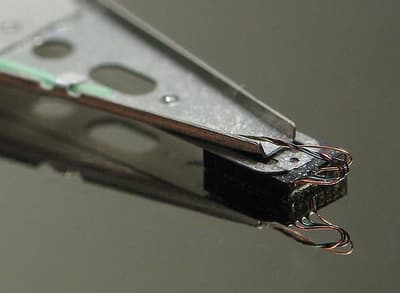
Inside, the arrangement is almost absurdly delicate. Data sits on magnetic platters. A tiny actuator head reads and writes that data, but during normal operation it does not scrape along the surface. It rides above it on a cushion of air created as the platters spin.[1][2]
The gap is not a comfortable safety margin. Modern drives can have a flying height measured in only a few nanometers. One source describes it as about 3 nanometers, roughly 40 atoms high; another notes that modern flying heights are on the order of about 5 nanometers.[1][4] At that scale, even a particle of smoke, a fingerprint-thin obstruction, or disrupted airflow can become a mechanical disaster.[4]
The Drive Has To Breathe
A barometric, or breather, filter lets air move while blocking particles above a certain size, often around 0.3 microns.[5] The filter is there because the drive needs clean air and changing pressure, a combination that makes high altitude awkward.
The head is not held up by a fixed spacer. It is flying. In early commercial disk drives, engineers used forced air to maintain a much larger gap. By the IBM 1301 in 1961, the head rode on a hydrodynamic air bearing slider, generating its own cushion of pressurized air and flying much closer to the disk surface.[4]
Near sea level, that engineering disappears into ordinary computer behavior. The disk spins, the head floats, and the metal box feels solid and dependable. Climb high enough, though, and the air thins. At 11,500 feet, atmospheric pressure is roughly 65 percent of sea-level pressure, according to SyncRetreat’s altitude planning notes.[3]
With less pressure, the air bearing has less to work with. Datarecovery.com describes the failure plainly: if pressure is too low, the air cushion can become insufficient, and the actuator heads can crash into the platters, causing immediate data loss.[2]
Why 10,000 Feet Matters
Many consumer hard drives are designed for operation below about 10,000 feet above sea level.[2][5] Above that, a drive may still spin up and seem normal for a while. The risk is reliability, not whether the machine can survive one dramatic power-on moment.
That is why the Leh retreat says it runs zero spinning hard drives in its servers or network storage devices. Its storage is SSD-only, and residents are warned not to rely on external spinning drives at altitude.[3]
The safer alternatives are not mysterious. Solid-state drives have no spinning platters, no actuator head flying on an air bearing, and no spindle, so they are not subject to the same altitude limitation as traditional hard drives.[2][3] Some hard drives are also sealed and filled with helium, which supports high-capacity designs and can operate at very high elevations, though they are generally more expensive than standard consumer drives.[2][5]
The odd part is how ordinary the danger looks. No broken screen, no snapped cable, no dropped laptop. Just a cheap external drive carried into mountain air, its platters spinning as always, its head trying to fly on a cushion that is no longer quite thick enough.
Sources
- Instant Fundas, “Interesting hard drive facts you probably didn’t know”
- Datarecovery.com, “High Altitudes Can Cause Hard Drive Failures”
- SyncRetreat, “High-Altitude Hardware Failures: What Actually Breaks at 11,500 Feet and How to Prevent It”
- Wikipedia, “Flying height”
- Datarecovery.com, “Are Hard Drive Enclosures Airtight?”