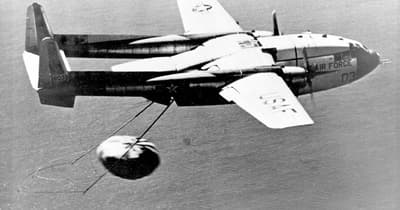
On its third pass over a white parachute south of Honolulu, an Air Force C-119 flew low enough for a trailing hook to grab the thing America had just dropped from orbit. A winch operator pulled it in after a 27-hour, 450,000-mile trip through space. Inside was not an astronaut, a radio, or a souvenir. It was film.[1]
In 1960, the United States recovered spy satellite film by catching a falling CORONA capsule in midair. The C-119 crew snagged Discoverer 14's parachute before the bucket hit the Pacific, bringing home the first successful film from an orbiting reconnaissance satellite.
Discoverer 14 launched from Vandenberg on August 18, 1960, under a name that sounded safe enough for newspapers. NASA's archived mission page says the program was publicly described as a way to test large satellites and return biological packages from orbit. Its classified job was sharper: photograph the Soviet bloc after U-2 flights had become too dangerous.[1]
The hardware trusted gravity, parachute cloth, and a waiting airplane. JPL's mission library describes CORONA satellites using film canisters, nicknamed buckets, that came home inside reentry capsules. The plan was to catch them during parachute descent with specially equipped aircraft. If the plane missed, the bucket was supposed to float until a crew could fish it from the ocean.[2]
Eisenhower had authorized the CIA and Air Force project in early 1958, a few months after Sputnik. The National Air and Space Museum says the satellite was called CORONA inside the intelligence world and Discoverer outside it, where the same launches could be explained as scientific research.[3]
After a string of misses, Discoverer 13 proved a capsule could return from orbit. One week later, Discoverer 14 carried a camera, circled Earth, released its package over Alaska on the 17th pass, and sent the parachute down toward the Pacific. A crew from Hickam Air Force Base spotted it 360 miles southwest of Honolulu. On the third try, at about 8,000 feet, their recovery gear snagged the canopy.[1]
Cold War intelligence depended, for a while, on a maneuver that looked closer to barnstorming than science fiction. The satellite could cross borders nobody could safely fly over. The evidence still had to be rescued by people watching the sky and lining up a hook behind a propeller plane.
Discoverer 14's film changed the scale of what a camera in orbit could do. The Air and Space Museum says it returned the first U.S. photographs of Soviet territory taken from space, covering more Soviet territory than all earlier U-2 aircraft flights combined.[3] JPL says the wider CORONA program later produced more than 860,000 declassified images, useful for intelligence, mapping, and research.[2]
The recovery photograph keeps the old weirdness visible: a C-119 over open water, two dark lines trailing behind it, a small capsule hanging where a fish might be.[4] For one moment, the space age did not look like a control room. It looked like a crew leaning into the window, trying not to miss the bucket.