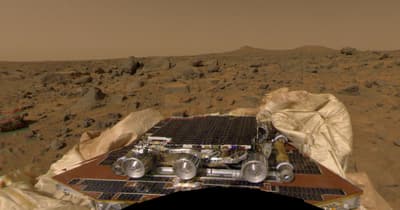
For one summer afternoon in 1997, NASA asked a spacecraft to do something no careful machine is supposed to do. After a seven-month trip to Mars, Mars Pathfinder hit the planet inside a swollen bundle of airbags, skipped across the ground like equipment thrown from a truck, and only then unfolded into a laboratory.
Mars Pathfinder landed on Mars by using airbags, bouncing about 15 times and rising as high as 50 feet before stopping. The beach-ball arrival helped deliver Sojourner, the first robotic rover to drive on the Martian surface.
On July 4, 1997, Pathfinder entered the thin Martian atmosphere, slowed under a heat shield and parachute, fired rockets near the surface, and struck the ground at about 31 mph. NASA says the airbag-wrapped craft bounced for roughly 2.5 minutes before coming to rest about six-tenths of a mile from its first impact point.[1]
At Sandia's High Altitude Chamber, the airbag idea had to be beaten in miniature before NASA trusted it at full distance. Engineers built a 0.38 scale prototype, ran computer predictions, changed the pressure around it, dropped hardware at representative speeds, and watched for the one result that mattered: a lander roughed up enough to prove it could still function. The technical paper's verb is "validate," but the ritual was more ordinary. They rehearsed a crash until the crash became part of the machine.[2]
Before Pathfinder could become a science mission, it had to survive a planned loss of composure. The people building it were making a delicate machine that could be thrown at Mars and still wake up. Their confidence came from practicing the ugly part: the drop, the slap, the bounce, the pause before anything opened.
Sojourner rolled down from the lander as a rover small enough to seem almost like a toy, about 23 pounds according to Britannica, but it changed what Mars exploration could look like. Pathfinder carried a moving scout that could nose up to rocks, test soil and stone, and turn the landing site from a postcard into a place with errands, wheel tracks, named rocks, and daily commands sent from Earth each morning.[3]
Each command arrived at a place that had started as a crash site. By Sept. 27, the mission had sent back 2.3 billion bits of information, more than 16,500 lander images, 550 rover images, chemical analyses of rocks and soil, and weather data. NASA says the results supported the idea that ancient Mars had once been warmer and wetter than the dry plain Pathfinder photographed.[1]
A beach ball is the wrong shape for human dignity. That is why the landing still feels charming. NASA did not make the arrival graceful. It wrapped a machine in fabric bladders, let physics knock it around, waited for the bouncing to stop, and opened the petals. The first rover began its work beside the crumpled airbags that had taken the beating first.