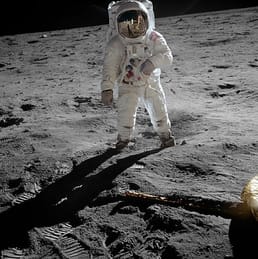
In 1969, the United States landed on the Moon and then, almost immediately, began sketching out what would come next. Not in the vague, inspirational way politicians talk about the future. In the concrete, engineering-heavy language NASA uses when it thinks the money might keep flowing.
And what NASA thought might come next was astonishing. If funding stayed at Apollo levels, the Space Task Group argued, the country could move from a few flags-and-footprints missions to something much bigger: a lunar orbit station by 1978, a lunar surface base by 1980, and then, remarkably, a crewed mission to Mars in either 1981 or 1983.[1]
This is the part of the space age people tend to forget. Apollo is usually remembered as a climax, a daring sprint that ended with Neil Armstrong’s bootprint and a few more increasingly ambitious landings. But inside NASA, Apollo was not supposed to be the end of the story. It was supposed to be the opening move.
The Moment NASA Thought the Future Had Arrived
By mid-1969, Apollo had done something extraordinary. It had taken an almost impossible national goal, landing men on the Moon and returning them safely to Earth, and turned it into a working industrial system. Saturn V rockets flew. Lunar Modules landed. Command and Service Modules carried crews across cislunar space. The machinery existed. The expertise existed. And just as importantly, there were people inside NASA who believed the political will might exist too.[1]
So the Space Task Group produced an optimistic plan. It assumed NASA would continue to receive Apollo-level funding. That assumption now looks almost fantastical, but at the time it did not seem absurd inside the agency. If the United States had just spent the 1960s building a Moon program, why stop precisely when that machinery had begun to work?[1]
Under that logic, the path forward was clear. First, extend Apollo. Then build infrastructure. Then push outward.
The Moon Was Supposed to Become a Place, Not Just a Destination
One of the most revealing parts of the post-Apollo planning is how quickly NASA moved beyond the idea of isolated lunar visits. Right after the first Moon landings, the agency was already imagining modified Lunar Modules helping establish small lunar outposts around 1971 or 1973, after Apollo 20, then expected to be the program’s final mission.[1]
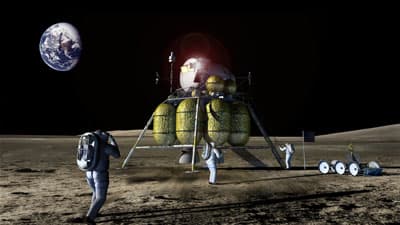
This fell under the Apollo Applications Program, a now mostly forgotten branch of Apollo history whose lone major survivor was Skylab.[1] But the original idea was much broader. NASA imagined launching multiple Saturn Vs to the Moon. Some would carry unmanned LM shelters, essentially Lunar Modules redesigned for staying power rather than return capability. Without an ascent stage, they could carry more supplies, more science gear, more life-support consumables, better communications, more power, and more room for crews to actually live and work.[1]
This is where the vision begins to feel strikingly modern. NASA was no longer thinking only in terms of planting crews on the surface and bringing them straight back. It was thinking about logistics chains, semi-permanent habitation, and the problem that defines all real exploration: how do you stop visiting a place and start operating there?
The Lunar Taxi Idea
The architecture for those early outposts was clever. A crewed Command and Service Module would accompany an LM shelter to the Moon and brake the shelter into lunar orbit, but because the shelter had no ascent stage, it would remain on the surface while the CSM stayed in orbit conducting science.[1]
Separate Lunar Module “taxis” would then bring crews of three down to the shelter.[1] The language itself is revealing. Taxi. It suggests routine, repetition, a transportation system rather than a heroic one-off. NASA’s planners were, in other words, already trying to make the Moon boring in the most important possible sense. Not unimportant. Operational.
That is often the hidden threshold in technological history. The breakthrough is dramatic. The future arrives with television cameras and national speeches. But the real transformation begins only when someone starts planning schedules, support equipment, and reusable procedures. Apollo captured public imagination because it was spectacular. The follow-on plans mattered because they were trying to turn spectacle into infrastructure.
Then Came the Bigger Leap
And the Space Task Group did not stop at improved lunar expeditions. Its longer-range plan envisioned a lunar orbit station in 1978 and a lunar surface base in 1980.[1] That progression says a great deal about how NASA was thinking. The Moon was not merely a target to be reached. It was becoming a proving ground, a place where orbital operations, surface systems, habitation technology, and sustained logistics could all be developed together.
And from there came the boldest step of all: a human mission to Mars, projected for 1981 or 1983.[1] It sounds almost delusional from the standpoint of the twenty-first century, when even returning humans to the Moon has taken decades of delay, redesign, and political negotiation. But from inside 1969, it followed a certain logic. If you had the rockets, the production base, the momentum, and the money, why not keep climbing?
The key phrase there, of course, is and the money.
The Future That Lost a Budget Fight
President Nixon rejected the ambitious Space Task Group plan.[1] Instead of maintaining Apollo-era spending and pursuing that ladder from lunar outposts to Mars, his administration chose a different path, backing development of the space shuttle.[1] The shuttle would become one of the most recognizable, controversial, admired, and criticized machines in the history of spaceflight. It was loved and hated for good reason. It kept American human spaceflight alive, but it also represented a very different future from the one NASA had briefly imagined in 1969.
This is the hinge point. One version of the future emphasized continuation: keep the Saturn-class momentum going, extend Apollo hardware, build outward, and use the Moon as the next operational frontier. The other emphasized a reusable transportation system centered in Earth orbit. One future aimed for deep-space presence. The other settled into an architecture much closer to home.
That choice did not merely cancel a few speculative diagrams. It changed the trajectory of the space age. Instead of lunar shelters, orbit stations around the Moon, surface bases, and an early push to Mars, the United States turned inward toward low Earth orbit.
Why the Plan Still Feels So Startling
What makes the 1969 planning so haunting is not just its ambition. It is the dates. Lunar orbit station in 1978. Lunar base in 1980. Mars by 1981 or 1983.[1] Those are not dates from some unreachable science-fiction century. They are dates that, at the time, sat just over the horizon.
It reveals how much Apollo distorted the sense of what was normal. Once a nation has built a rocket powerful enough to send humans to the Moon and has done it repeatedly, the leap from “first landing” to “permanent presence” can begin to seem smaller than it really is. Success creates its own optimism. Engineers start to believe that the hardest part is behind them. Institutions begin to mistake momentum for inevitability.
But momentum is not inevitability. It is a temporary political condition. And when that condition disappears, even the most sophisticated plans can collapse into historical footnotes.
The Road Not Taken
The forgotten power of this story is that it reminds us Apollo was not abandoned because NASA lacked ideas. It was abandoned because ideas are cheap compared with national commitment. The agency had concepts for lunar shelters, lunar transport systems, orbiting stations, surface bases, and the next great leap to Mars.[1] What it did not have was a country willing to fund that sequence once the symbolic victory of beating the Soviets to the Moon had already been won.
That is why this plan still matters. It is not merely a trivia item about a road not taken. It is a case study in how futures die. Not because they are technically impossible, but because they become politically inconvenient. The grandest spacefaring visions often fail not in laboratories, but in budgets.
And so one of the strangest artifacts of the Apollo era is this: at the very moment humanity first reached the Moon, NASA was already imagining the Moon as old news. In those optimistic charts and schedules, the real destination was Mars.[1]