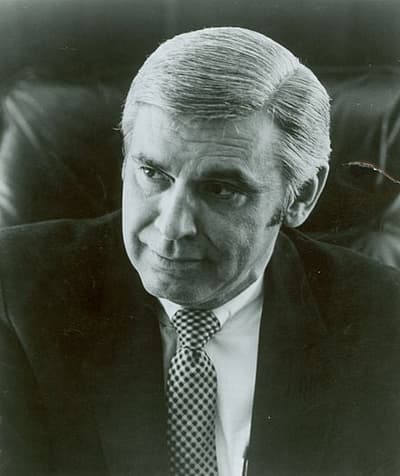
Leo Joseph Ryan Jr. was born in Lincoln, Nebraska, on May 5, 1925, and his family moved through Illinois, Florida, New York, Wisconsin, and Massachusetts before he finished school. He graduated from Campion Jesuit High School in Prairie du Chien, Wisconsin, in 1943, then received V-12 officer training at Bates College and served in the United States Navy as a submariner from 1943 to 1946. He earned a B.A. from Creighton University in 1949 and an M.S. there in 1951. By 1956 he was teaching English at Capuchino High School and sitting on the South San Francisco city council, where he stayed until 1962 [1].
In 1962, Ryan was elected mayor of South San Francisco. He served less than a year before winning the 27th Assembly district race by 20,000 votes, and he held that seat until 1972, when voters sent him to the U.S. House of Representatives [1]. He had lost an earlier Assembly bid in 1958 to Republican Louis Francis, and he served as a delegate to the Democratic National Convention in 1964 and 1968 [1].
After the Watts riots of 1965, Ryan went to the Los Angeles area and took a job as a substitute school teacher so he could investigate and document conditions there [1]. Jackie Speier, a Ryan aide who later served in Congress herself, described the approach as experiential legislating [1].
In 1970, Ryan used a pseudonym to have himself arrested, detained, and strip-searched as part of an investigation into California's prisons [1]. He stayed ten days as an inmate at Folsom State Prison while presiding as chairman of the Assembly committee that oversaw prison reform [1]. As an assemblyman he also authored what became known as the Ryan Act, which established an independent regulatory commission to monitor educational credentialing in California [1].
Ryan entered the House in 1973 and was reelected three times [1]. He traveled to Newfoundland with James Jeffords to investigate the killing of seals, and he became known for criticizing the lack of congressional oversight of the Central Intelligence Agency [1]. He co-authored the Hughes-Ryan Amendment, passed in 1974, which requires the president to report covert CIA activity to Congress [1].
By 1978, reports had surfaced of human rights abuses at Jonestown and of people being held there against their will [3]. The settlement was a remote commune in Guyana built by the Peoples Temple, the American religious organization led by Jim Jones, who ordered its construction in 1974 and told followers he was building a socialist paradise free of the United States government [2][3]. Ryan led a delegation to the commune in November 1978 to investigate those reports [3].
On November 18, 1978, Ryan and four others were shot at an airstrip in Port Kaituma as he and his party tried to leave with former Temple members who wanted out [1][2]. Jones had ordered the killings [2]. Ryan was the second of two sitting members of the House to be killed in office, after James M. Hinds in 1868 [1].
Later that day, 909 people died at Jonestown itself, all but two from apparent cyanide poisoning, and many were injected against their will [2]. Counting four other Temple members who died in Georgetown at Jones's command, 918 people died across three locations [2]. Ryan was posthumously awarded the Congressional Gold Medal in 1983 [1].