Sporting prints from the 18th century show Dalmatians running alongside horse-drawn coaches, and breed historians trace depictions of the dogs with horses back to 1729 [3]. Wealthy aristocrats in England, Scotland, and Wales sought out the spotted dogs for their coaches, and the more dogs a household could run beside a carriage, the higher its owner stood on the social ladder [2]. The breed was developed as a coach dog and typically worked in small packs [1].
A working coach dog covered as much as 20 to 30 miles in a day, usually traveling in pairs [2]. The job was not merely decorative. Dalmatians had an unusual ability to soothe the horses pulling a cart, keeping them from panicking and bolting even when danger was near, which protected both the people in the carriage and the goods it carried [1].
Fire brigades in the 1700s used the same kind of horse-drawn carriages, and the dogs followed. Alison Merritt, historian for the Dalmatian Club of Canada, calls it an easy, natural transition from coaching to accompanying horse-drawn firefighting equipment [3]. When they were not on the road, the dogs lived at the firehouse, and their presence there was common enough that they became known as firehouse dogs [1].
Early fire engines were hand-pumped machines that firefighters pulled themselves, and only around the 1850s did heavy steam-driven engines make horsepower a necessity [2]. Once horses took over the pulling, Dalmatians ran with the apparatus as living sirens, barking through the streets to clear pedestrians out of the way [2]. They were trained to bolt out of the firehouse when the alarm sounded and bark to warn bystanders that the wagon was coming [2].
Once the engine reached a burning building, the dogs had a second job. Horses are naturally afraid of fire and uneasy around crowds, and a Dalmatian standing beside them could keep them calm while the crew worked [1][3]. The dogs also guarded the horses and equipment, making sure no one walked off with them in the confusion [2]. One account describes Dalmatians nipping at horses' knees to keep them from dozing off on the job [3].
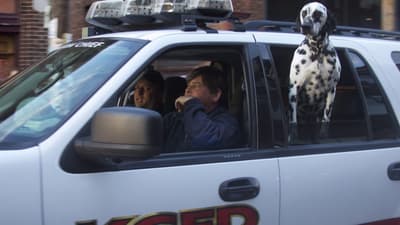
The first motorized fire engine appeared in 1897, and most departments switched from horses during the 1910s. The last firehorse retired in 1922 [2]. Dalmatians no longer needed to keep pace with the apparatus, but many firehouses kept them anyway as companions and watchdogs [1].
New York City's fire service produced some of the best known of these dogs, including Jack the Bum, Spot, and Mike, who worked in the late 19th and early 20th centuries [3]. Stories credit them with sprinting ahead of the engines to alert pedestrians and, in some tellings, running into burning buildings with their crews [3]. Firehouses still keep Dalmatians today, and the dogs still sometimes ride along as crews respond to emergencies [1].