On August 27, 1957, a four-inch-thick steel cap flew off the top of a 500-foot shaft at the Nevada Test Site. It had been sitting above a nuclear device detonated in the Pascal-B experiment, part of Operation Plumbbob [1][2]. A camera filming at one frame per millisecond caught the plate in a single frame [1]. Robert Brownlee, the Los Alamos astrophysicist who designed the test, worked from that frame to calculate a speed of roughly six times escape velocity [1].
Operation Plumbbob ran from May 28 to October 7, 1957, at the Nevada Test Site and consisted of 29 explosions, all but two of which produced nuclear yield [2]. Twenty-one laboratories and government agencies took part [2]. About 18,000 Air Force, Army, Navy and Marine personnel participated in exercises Desert Rock VII and VIII [2]. Almost 1,200 pigs were used in biomedical and blast-effects studies, including 719 on the 37-kiloton Priscilla shot [2].
In 1956, Los Alamos asked Brownlee to examine whether nuclear detonations could be conducted underground [2]. Pascal-A, detonated on July 26, 1957, in an unstemmed hole, became the first underground shaft nuclear test [2]. Brownlee designed it to contain fallout, lowering the device to the bottom of a column 3 feet wide and 485 feet deep and capping the top with a 4-inch iron plate [1]. The explosion came out of the column like a Roman candle, and the cap left the top "like a bat much hotter than hell" [1].
Brownlee then built Pascal-B to measure how fast the cap traveled [1]. The second column was 500 feet deep, and the camera ran at one frame per millisecond [1]. Because the cap appears in only one frame, the speed is an estimate built from the frame interval and the distance covered rather than a direct reading [1]. No photographs survive from the Pascal experiments; only government documents remain [1].
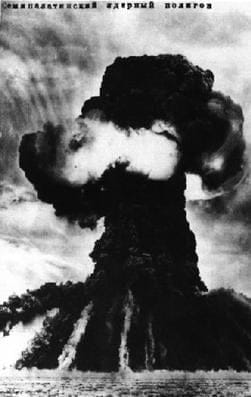
The first underground test, nicknamed Uncle, had exploded beneath the Nevada Test Site on November 29, 1951, buried only 17 feet down, and its mushroom cloud rose 11,500 feet [1]. The United States detonated 1,054 nuclear bombs in tests between 1945 and 1992, and by 1962 every test was conducted underground [1]. The Rainier shot of September 19, 1957, at 1.7 kilotons, was the first fully contained underground test, and seismologists worldwide detected it with ordinary instruments [2].
The steel bore cap is listed as missing, so the case rests on Brownlee's arithmetic and one frame of film [1][2]. He maintained that the plate was likely the fastest object humans have ever launched [1]. He died in 2018 at the age of 94 [1]. The object is more accurately described as a bore cap than as a manhole cover [2].
The story reached a wide audience through an old Quora thread before Brownlee described it to a reporter in 2016 [1]. It has the shape of an urban legend, and the television series MythBusters built its episodes around verifying or debunking claims of that kind [3]. What separates this case from a tall tale is the paper trail: test schedules, shaft dimensions and Brownlee's own account of the camera frame [1][2].