You look up at the soaring arches of a Gothic cathedral, the stone reaching toward the heavens, and there they are. Perched on the edge of the precipice, frozen in mid-snarl, are the monsters. They have the wings of dragons, the faces of demons, and the eyes of something that hasn't slept in centuries. We call them gargoyles. We imagine them as silent sentinels, perhaps guarding the holy ground below from the supernatural evils they resemble.
But if you were to climb those scaffolding steps and tap one on the shoulder, you might find a much more practical—and much less mystical—truth. Most of those terrifying creatures aren't there to fight demons. They aren't there to protect your soul. In fact, they aren't even gargoyles.
The Identity Crisis of Stone
In the world of architecture, names matter. In the world of Gothic masonry, there is a distinction so sharp it separates the legendary from the purely decorative. If you see a stone monster staring down at the streets of Paris or Tallinn, your instinct is to call it a gargoyle. But if that monster is solid stone—if it is merely a sculpture meant to catch the eye or add a sense of dread to a facade—you are technically wrong.
Architects call those statues grotesques[1]. They are ornamental, purely aesthetic, and entirely stationary. They might look like they’re about to spring to life, but they serve no mechanical purpose. They are the "fluff" of the cathedral world.
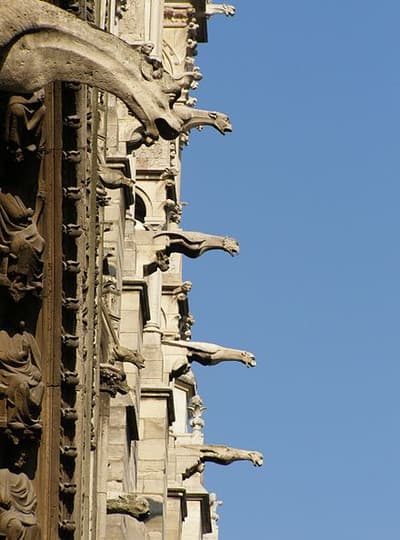
A true gargoyle, however, has a job. A very specific, very messy, very important job. To earn the title, a creature must be more than just a face; it must be a conduit. It must be a spout[1].
The Engineering of a Monster
To understand why this distinction exists, you have to understand the enemy of every great stone building: water. In the Middle Ages, rain wasn't just a nuisance; it was a structural threat. When rain hits a massive stone cathedral, it doesn't just sit there. It runs down the walls, seeping into the cracks, soaking the masonry, and eventually eroding the mortar that holds the entire mountain of stone together[1].
The architects of the Gothic era faced a dilemma. How do you move massive amounts of water away from the delicate skin of a building without letting it damage the foundation? The answer was as brilliant as it was bizarre. They turned the drainage system into a menagerie.
They carved long, hollow channels through the bodies of these stone beasts. The water would collect on the roof, travel through a gutter, and then be funneled into the mouth of the creature. The gargoyle would then "spit" the water out, projecting it far away from the walls of the building[1]. The monster wasn't just decoration; it was a high-performance plumbing fixture.
Function Over Fear
This realization changes the way we view the history of art. We often look at the grotesque imagery of the medieval period—the distorted faces, the hybrid beasts, the sheer chaos of the shapes—and assume it was a reflection of a world obsessed with the terrifying unknown. We think the artists were trying to capture the darkness of the human soul or the presence of the devil.
While there was certainly a spiritual element to the imagery—perhaps a belief that these figures could ward off evil[1]—the primary driver was often much more grounded. The "monsters" were a solution to a physics problem. They were a way to make the essential, unglamorous work of water management look like something divine, or perhaps something appropriately fearsome.
So, the next time you find yourself staring up at a cathedral, look closely at the mouth of the beast. If it's dry, you're looking at a grotesque—a beautiful, terrifying piece of art. But if you see the water rushing through its throat, projecting a stream into the air to save the stone from decay, you are looking at a true gargoyle: the most fearsome piece of plumbing ever devised.