
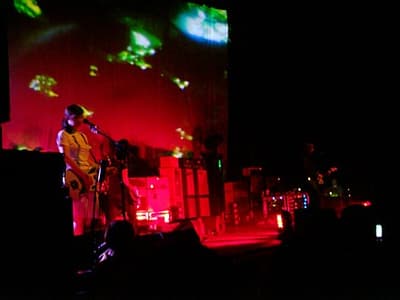
The insult came first.
British music journalists looked at a cluster of late-1980s bands, saw musicians standing nearly motionless onstage with their heads tilted down, and decided they looked like they were staring at their shoes. So they gave the scene a name that sounded faintly silly, faintly dismissive, faintly superior: shoegazing, later shortened to shoegaze.[1]
It was the kind of label critics love because it does two things at once. It describes. And it mocks. These were not rock stars lunging into the crowd or preaching from the lip of the stage. They were quiet, inward, almost anti-performative. To the British music press, that stillness looked awkward, maybe even precious. The joke was that the bands seemed more interested in their footwear than their audience.
Except that was never really the point.
They were looking down because, in many cases, they had to. At their feet sat clusters of guitar effects pedals, the machinery behind the sound itself.[1] If you wanted those vast blurred walls of guitar, the washed-out vocals, the feedback, the swooning distortion, the almost oceanic sense of volume, you did not just stride around the stage tossing your hair. You watched your feet. You adjusted settings. You managed the storm.
A Genre Named by People Standing Outside It
Shoegaze emerged in the United Kingdom in the late 1980s as a subgenre of indie and alternative rock.[1] Its sound was dense but dreamy, loud but strangely soft around the edges. Vocals were often submerged rather than projected. Guitars were less about riffs than texture. Distortion, effects, feedback, and layers of sound mattered so much that the songs could feel less like performances than weather systems.[1]
That is part of what made the name so revealing. The critics were describing what they could see, but not necessarily what was happening. From the outside, the musicians looked passive. From the inside, they were doing something highly technical and highly deliberate. The apparent stillness concealed constant control.
In other words, shoegaze was named out of a misunderstanding of the performer’s concentration. Which is a very British way for a genre to be born.
Why the Musicians Were Looking Down
The explanation is wonderfully unglamorous. These bands relied heavily on effects pedals during live shows, and that meant performers were often looking down at the controls at their feet.[1] The sound depended on them. Change the pedal chain, change the texture. Hit the wrong switch, and the song became a different song.
This matters because shoegaze was never just a mood. It was engineering disguised as atmosphere. The genre’s signature sound, obscured vocals, guitar distortion and effects, feedback, and overwhelming volume, did not arise by accident.[1] It had to be built, layer by layer, often in real time. What critics translated as stage shyness was, at least in part, a musician tracking a complicated signal path.
There is something almost perfect about that mismatch. Rock criticism traditionally prizes visible charisma. Shoegaze redirected attention somewhere less photogenic, toward sound design, immersion, texture, and sonic weight. The body onstage became less expressive at the exact moment the music became more enveloping.
The Sound That Made the Joke Stick
Part of why the term survived, even after its mocking origins, is that the music really did feel inward-looking. Shoegaze was often described as ethereal, blurred, immersive, and overwhelming all at once.[1] It was not trying to command the room in the old rock sense. It was trying to dissolve it.
The vocals often came through half-hidden, as if drifting in from another room. The guitars did not merely accompany the song. They flooded it. Feedback was not a mistake to eliminate but a texture to harness. Distortion was not there to make the music dirtier so much as bigger, softer, stranger. Shoegaze took tools associated with aggression and used them to create dream states.
That is one reason the genre is so often linked with “dream pop,” even though the terms are not identical.[1] Both can feel hazy and atmospheric. But shoegaze carried more weight, more noise, more amplifier air. It floated, yes, but it floated with enormous mass.
The Stillness Was the Performance
There is another reason the shoe-staring image landed so hard. The bands did not answer it by becoming more visibly theatrical. Their stage presence was often detached, introspective, and non-confrontational.[1] In a musical culture that still carried expectations of swagger, that could read as refusal. Or insecurity. Or boredom.
But it can also be read another way. Shoegaze did not reject performance. It relocated it. The drama was not in the body language. It was in the sound. What looked static was often the visible surface of intense sonic activity, with musicians shaping waves of guitar noise and effects into something immersive enough to swallow the room.
That helps explain why the name feels both wrong and right. Wrong because it began as a sneer. Right because it accidentally captured the physical posture created by the genre’s actual methods. The critics meant to make the bands seem small. Instead, they named a style that would become huge.
From Mockery to Identity
Genres are often named by outsiders first and embraced later, and shoegaze fits that pattern beautifully. A dismissive press term became the accepted label for one of the most distinctive British rock styles of its era.[1] The joke outlived the joke-makers.
That happens because good genre names do not need to be fair. They just need to stick. “Shoegaze” stuck because it was vivid, easy to remember, and attached to something genuinely recognizable, even if the first interpretation missed the point. Yes, the musicians looked down. No, it was not because they were transfixed by their footwear. They were operating the sound world beneath them.
And that reversal is the most interesting part of the whole story. The name suggests passivity. The reality was labor. The name suggests self-consciousness. The reality was concentration. The name suggests a band disconnected from the audience. The reality was a band trying to create an experience so immersive that the audience would stop thinking about the stage entirely.
Why the Origin Still Matters
To know where the word came from is to understand something larger about how music scenes are interpreted. Critics often name what they can easily caricature. Musicians are usually busy building something more complicated. In shoegaze, the gap between those two views became permanent enough to turn into genre history.
So yes, the term came from British critics mocking performers for always seeming to look down at their shoes while they played.[1] But the reality underneath the insult was more technical and more interesting. Those musicians were often monitoring and controlling the effects pedals that helped produce the sound in the first place.[1]
Which means shoegaze may be one of the few genres whose name began as a put-down and ended up preserving a hidden truth. The bands really were staring downward. They just were not looking at their shoes. They were looking at the machinery that made the dream possible.