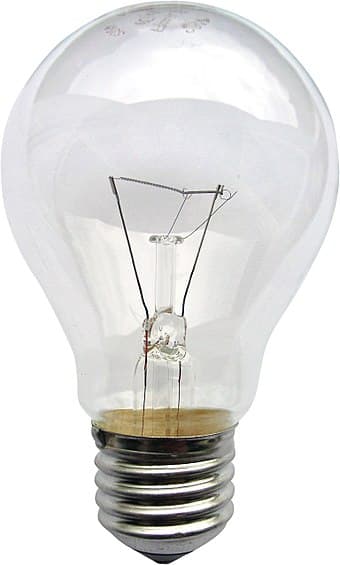
Thomas Edison filed his screw-base patent applications in 1881 and 1890, and the thread he settled on measured 1 inch in diameter with 7 threads per inch, a size later standardized as E26 [2]. Edison screw bases are right-hand threaded, so a bulb tightens when turned clockwise and loosens when turned counterclockwise [2]. The same convention covers the E12, E17, E26 and E39 sizes used for mains-voltage lamps in North America [2].
Fact Republic's fact #63067 states that the New York City subway used light bulbs with left-handed threads that tighten counterclockwise, so anyone who stole one could not use it in an ordinary home fixture [8]. The claim has circulated for years in trivia lists and hobbyist forums [9].
A BulbCollector forum poster reported finding two GE 100-watt, 120-volt bulbs with left-hand threaded bases in a box bought at a thrift store for $3, and noted that they would not fit a regular socket at all [9]. Another poster in the same 2006 thread recalled hearing that left-hand bulbs were used in old-style subway cars [9].
Bicycle left pedals, bench grinder left wheels and the securing nuts on some circular saw blades all carry left-hand threads, because applied torque would otherwise loosen a right-hand nut [3]. A screw thread turns rotation into linear motion, and its handedness sets which direction the threaded part travels [6]. Right-handed is the default by convention, which is why a reversed bulb stands out [3].
One BulbCollector contributor wrote that GE still mass-produced left-hand threaded lamps and that they first appeared in the 1970s at the request of San Francisco's public transport department, to deter theft from tram cars [9]. That poster gave the base the designation EX26 rather than E26 [9].
A 2026 article on parkingday.org examined the question and concluded that standard right-hand thread bulbs are used throughout the New York City system [7]. The same piece describes shatter-resistant bulbs, protective cages and tamper-proof fixtures that require special tools for replacement [7]. Subway lighting has to survive constant vibration, dust and humidity, which pushes maintenance toward long-life lamps [7].
The official station count is 472, or 423 when station complexes are counted once, and 470 of those stations are served 24 hours a day [1]. Nearly all station entrances carry color-coded globe or square lamps that mark their status, which puts thousands of lamps at street level [1]. The subway opened on October 27, 1904, when a 9.1-mile line ran from City Hall north to 145th Street [4].
A typical 120-volt incandescent bulb produces about 16 lumens per watt, and less than 5 percent of the energy it draws becomes visible light [5]. The MTA has been moving toward LED lighting to cut energy use and maintenance [7]. The reverse-thread story persists partly because it offers a clever, low-tech solution to a modern problem, but the fixtures do the work [7].