At the games staged for Julius Caesar, while Rome was still living inside the shock of his murder, people looked up near evening and saw a bright, hairy star rise in the sky. Pliny the Elder later said it appeared for seven days, around the eleventh hour, and that the crowd took it to mean Caesar had joined the gods.[1]
Caesar's Comet, also called the Julian Star, was a bright comet seen in July 44 BC and interpreted in Rome as proof of Julius Caesar's deification. Octavian, Caesar's adopted heir, turned that celestial sign into one of the most useful symbols of his rise to power.
The games were the Ludi Victoriae Caesaris, staged by the young Octavian in Caesar's honor a few months after the assassination.[1] Ancient writers tied the apparition to those celebrations, and the object acquired names that already sounded political: Sidus Iulium, the Julian Star, and Caesaris astrum, the Star of Caesar.[2]
Modern astronomy gives the visitor a colder label, C/-43 K1. It was a non-periodic comet, with an observation arc of about 54 days and a calculated perihelion, its closest approach to the Sun, on May 25, 44 BC.[2] Its orbit is hard to reconstruct. Modern summaries point to two uncertain ancient reports, one from China and one from Rome, and note that many possible paths can fit so little evidence.[2]
Romans did not need an orbit. They had a public spectacle, a recent murder, and a bright object arriving at exactly the wrong, or useful, moment. Suetonius reported that, as the celebrations began, "a comet shone for seven successive days" and was believed to be Caesar's soul.[3] Pliny preserved a similar tradition, emphasizing that the star was very bright and conspicuous.[1] Cassius Dio, writing later, also connected the apparition to the games and to the crowd's response.[1]
The Star Becomes a Family Emblem
Octavian did not need to invent the sky. He needed to claim what people thought they had seen. If Caesar had become divine, then his adopted heir was not merely another young Roman with soldiers, enemies, and a famous name. He could present himself as the son of a god.[1]
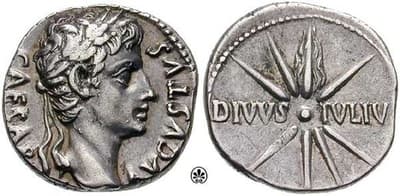
The symbol soon became small enough to carry. Coins minted under Augustus showed Caesar's star, sometimes as an eight-rayed star with a tail rising upward, paired with the words for the divine Julius.[3] A celestial event that had lasted a week could now pass hand to hand in silver and gold. A Roman did not have to witness the comet to read the message stamped into the metal.
Poets helped make the image last even longer. In the Metamorphoses, Ovid imagined Venus lifting Caesar's soul and kindling it as a star above Rome.[1] The later poetic line, "To make that soul a star that burns forever, Above the Forum and the gates of Rome," belongs to the same tradition: the dead ruler translated into permanent light.
The comet itself may have been extraordinarily bright. Some modern accounts describe it as possibly one of the brightest daylight comets in recorded history, with estimates comparing its apparent brightness during the outburst to Venus.[4] Other details remain uncertain because the surviving observations are imprecise.[4] The Roman meaning is easier to trace than the orbit.
A body of ice and dust moved through the inner solar system. Rome made it into ancestry, legitimacy, coinage, poetry, and cult. For seven days, a bright object rose in the sky. For generations afterward, its little star kept shining from the reverse of Roman coins.