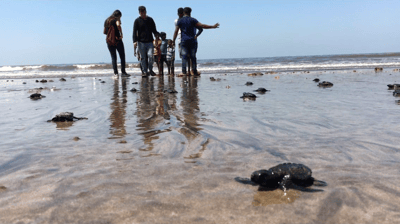
On 22 March 2018, volunteers clearing Versova Beach in north-west Mumbai found olive ridley hatchlings crossing the sand toward the Arabian Sea. More than 80 of the palm-sized turtles were seen making the short, exposed walk to the water [1][12]. Afroz Shah, the lawyer who organised the clean-up, posted the news the same day and called it a historic moment for the city [1]. Forest officials told reporters the last such sighting on the beach had been 20 years earlier [12].
Prashant Deshmukh, an environmental officer with the Maharashtra state government, told AFP that around 90 to 95 hatchlings were found and that volunteers released them safely to the sea [8]. Newly emerged olive ridleys measure 37 to 50 mm in carapace length and weigh between 12.0 and 23.3 g [3]. The species is the second-smallest and most abundant of the world's sea turtles, swimming in warm tropical water across the Indian and Pacific Oceans [3].
By 2015, Versova Beach was choked with up to 1.7 metres of rotting refuse, most of it plastic [2]. Shah told CNN the waste stood 5.5 feet high and that a man could drown in the plastic [1]. He moved into the neighbourhood in October 2015 and began picking up litter with Harbansh Mathur, an 84-year-old neighbour who has since died [2].
Those Sunday sessions grew into the Versova Residents Volunteers, who called their weekly shifts dates with the ocean [2]. Over 21 months the group removed close to 5,300,000 kilograms, or 11,684,500 pounds, of trash [2][1]. Other tallies put the haul above 13 million kilograms across fewer than 126 weeks [10]. Volunteers also cleaned 52 public toilets and planted more than 50 coconut trees [2]. The United Nations Environment Programme named Shah a Champion of the Earth in 2016, and the effort was described as the world's largest beach clean-up [2][1][4].
N Vasudevan, additional principal chief conservator of forests, told PTI that olive ridleys lay eggs only at places they feel safe and secure, and that no nesting had been recorded at Versova for several years [12]. Versova is an old Koli fishing village, now part of a city of almost 12.5 million people [2][6]. Beach litter arrives from beach users, rivers and ocean currents, and researchers argue that environmental education is needed to cut it at the source [5].
Eggs incubate under the sand for about 50 days, and dogs and birds of prey take a heavy toll on the young [8]. Volunteers camped on the beach to guard the turtles during their walk [1]. The forestry department said it would keep round-the-clock surveillance and ban excavation work while the hatchlings emerged [8]. Deshmukh said he would push for a turtle rescue centre near the nesting site [11].
Olive ridleys lay eggs at Velas, Anjarle, Harihareshwar, Maral and Diveagar in Maharashtra, and the largest nesting ground in the world lies off Odisha on the Bay of Bengal [11]. The species is best known for arribadas, synchronised mass nestings in which thousands of females come ashore on the same beach [3]. The International Union for Conservation of Nature lists the olive ridley as vulnerable [11][7]. An adult olive ridley was rescued from Juhu Beach, a few kilometres south, in July 2017 [12].
The UN Environment Programme launched its global Clean Seas campaign after Shah's work, and Prime Minister Narendra Modi praised the transformation of Versova on his radio programme in May 2017 [4]. CNN later named Shah one of its Top 10 Heroes of the Year for 2019 [4]. The clean-up has been credited with bringing the turtles back to a beach they had abandoned [9]. Shah told the UN he is an ocean lover and hopes the work is a beginning for coastal communities across India and the world [1].