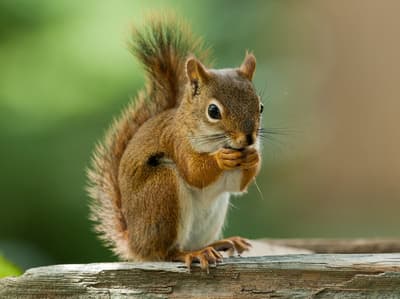
On a day in 1856, a crowd gathered under a tree near New York City Hall to stare at an escaped pet squirrel, and police were called in to catch it [10]. A newspaper report on the "unusual visitor" treated the sight as news, because squirrels were then rare in American cities [1][6].
By the 1850s, the eastern gray squirrel had largely been driven out of American city centers, though it was native to the eastern half of the continent [2][9]. The first documented reintroduction came in 1847, in Philadelphia's Franklin Square [7][8]. Releases followed in Boston and New Haven in the 1850s [8][10].
Early releases were small in scale and meant to "beautify and add interest to the parks," Benson wrote [8]. An 1853 article in the Philadelphia press described stocking public squares with squirrels, deer, and peacocks as a step toward making them "truly delightful resorts" [10]. The experiments stopped by the 1860s, when many of the animals had died out or been killed over worries that they would disturb birds and set off insect problems [7][8].
Releases began again in the 1870s, on a larger scale, as cities built expansive parks in New York, Boston, Washington, D.C., and Chicago [8][9]. Central Park has held gray squirrels since 1877, and by the mid-1880s its population was estimated at 1,500 [7][8][10]. Historians tie the fashion to the parks movement associated with Frederick Law Olmsted and to a wider belief that nature in the city was essential to residents' health and sanity [8][9].
Park visitors were encouraged to hand out nuts, and security guards ensured the animals' safety [1][6]. Ernest Thompson Seton, a cofounder of the Boy Scouts, argued that feeding squirrels taught children to treat a weaker creature with compassion [1][8]. Benson found the same theme in children's literature and in the writings of reformers who hoped to cure children of cruelty [8].
By the early twentieth century, booming populations had turned the animals into a nuisance [7]. As horses, dairy cows, and slaughterhouse livestock left cities by the 1950s, pets, birds, and squirrels were nearly all that remained of the urban animal kingdom [1][6]. Many parks banned feeding by the 1970s, and Benson describes the reversal: what had been encouraged became something close to a sin [1][7].
Ecologists now count squirrels among the generalist species that thrive in cities, using parks, street trees, and gardens as habitat [4]. The eastern gray squirrel has been carried far beyond its native range, and since 2016 it has appeared on a European Union list of invasive alien species of concern, which bars importing, breeding, or releasing it there [2]. Wildlife agencies treat clashes between people and animals as human-wildlife conflict, a category with formal guidelines aimed at coexistence [5].
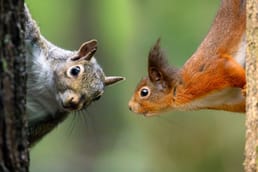
Tree squirrels descend a trunk headfirst by rotating their ankles 180 degrees, so the hind feet grip the bark from the opposite direction [3]. In cities, where predation risk is lower, white and black eastern gray squirrels turn up more often than they do in the woods [2]. Benson's case for keeping them is simple: it is good to live in a landscape where you see other creatures going around making lunch [1][6].