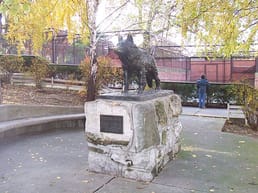
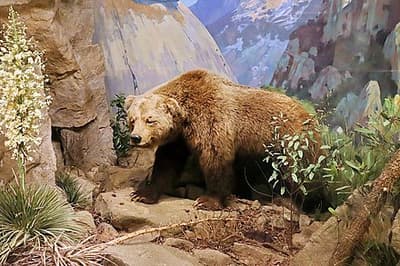
In the Santa Barbara Museum of Natural History, the California grizzly is no longer a moving danger but a specimen, the kind of animal you meet through a label and a preserved body.[1] The same bear still walks across California's flag, head low and paws planted, as if the state had managed to keep it.
The California grizzly bear, the animal on California's state flag, is listed as extinct, with 1924 commonly given as the extinction date. Its scientific name was Ursus arctos californicus, a lost California population of the brown bear.
The flag makes the bear feel permanent. The taxonomic record says otherwise. The California grizzly was a brown bear, classified as Ursus arctos californicus, and treated in the source record as an extinct population or subspecies rather than a separate mythical creature made for state stationery.[1] Its official conservation status is the blunt part: extinct, 1924.[1]
Before it became a civic emblem, the bear carried a name built around unease. “Grizzly” has been tied to the grizzled look of the animal's fur, with pale-tipped hairs, and also to “grisly,” meaning fear-inspiring. Naturalist George Ord classified a North American grizzly in 1815 as Ursus horribilis, a Latin name that does not flatter the animal into cuteness. It means a terrifying bear.[1]
A Real Bear Behind the Symbol
The scientific names around the California grizzly show how much sorting happened after humans tried to pin the animal down. The source lists older or related names including Ursus californicus, Ursus horribilis californicus, Ursus colusus, Ursus henshawi, and several others.[1] That clutter is not just bookkeeping. It is the paper trail of a large animal being described, renamed, compared, and finally remembered after its living population was gone.
The California grizzly was not a cartoon version of strength. It belonged to the same broad brown bear species as other grizzlies, and the source describes North American brown bears as closely related genetically.[1] The animal's public afterlife, though, became unusually Californian. Once the bear was placed on the state flag, it could stand for wildness, power, and an older landscape even as the actual bear disappeared from that landscape.
The contradiction is small enough to miss because flags are designed to simplify. A flag has room for a bear, not for the history of how that bear was classified, hunted, displaced, or lost. From a distance, California's bear still looks solid and available. The official status line underneath the animal tells a colder story: the image survived, the population did not.[1]
The Date on the Ghost
“Extinct, 1924” gives the emblem its sting.[1] A state can preserve a drawing, a mascot, a Latin name, and a museum specimen. It cannot preserve a predator merely by putting that predator on cloth. The California grizzly remained useful to public identity after it stopped existing as a living animal in California.
That is why the Santa Barbara specimen matters. It pulls the bear back out of abstraction. The animal on the flag can be waved, printed, worn, and repurposed endlessly. The specimen is a reminder that the symbol once had weight, fur, teeth, and a body that moved through the world before it became something people mostly encountered in names and images.[1]
So the California grizzly did not vanish from California altogether. It changed forms. It moved from valleys and mountains into taxonomy, museum collections, and the center of a state flag. The bear is still raised into the wind, walking on fabric after the last living one was gone.