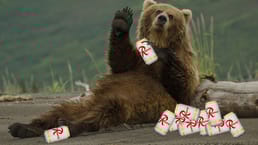
A broken window, burst bags of hot cocoa mix, and chocolaty paw prints across a camp kitchen floor are not the kind of evidence anyone wants to find before coffee. At a summer camp near Genesee, Colorado, counselors had locked the kitchen for the night. A bear found the weak point anyway.[1]
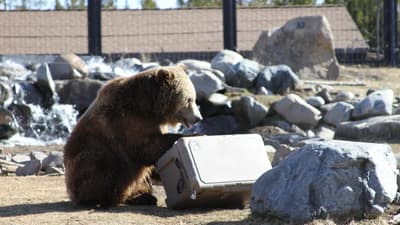
At the Grizzly & Wolf Discovery Center in West Yellowstone, Montana, resident grizzlies test coolers, dumpsters, garbage cans, and food containers by trying to break into them for 60 minutes. If the bears cannot open the container or get the food, it can pass as “bear-resistant” under Interagency Grizzly Bear Committee rules.
Wildlife biologist Wes Larson called that Colorado kitchen break-in a textbook case of food conditioning: a bear learns that people mean calorie-dense food, and the reward can outweigh its normal caution around humans.[1] After that, a campsite, porch, golf course, or garbage bin becomes a puzzle with a payoff.
Some of the bears at the Grizzly & Wolf Discovery Center arrived with that kind of history. The West Yellowstone nonprofit houses grizzlies that cannot survive in the wild, including animals that repeatedly got into trouble around human food.[1] Coram, a male grizzly whose weight has ranged from about 550 to 680 pounds depending on the season, wandered through Kalispell, Montana, checking porches for dog kibble before officials trapped him three times.[1] Spirit, a female grizzly, kept returning to a golf course in Whitefish even after relocations, including one as far as 100 miles away.[1]
The Job Interview Is a Cooler Full of Treats
At the center, that talent for finding food is turned into a public safety test. A manufacturer brings in a product, staff place it in the bear habitat, and the container is baited with especially enticing food.[2] Then the bears get 60 minutes to bite, paw, shove, roll, and pry at it.[2]
If a bear opens the container or obtains the food, the product fails. If the bear cannot open it or reach the reward, the container can pass as “bear-resistant” and receive certification through the Interagency Grizzly Bear Committee program.[2] A failed product can be modified and tested again later.[2]
The word “bear-proof” is the human shortcut. The official language is more cautious: bear-resistant. Cowboy State Daily notes that there is really no such thing as a 100 percent bear-proof container.[3] That caution is reasonable when the examiner is a grizzly working over hinges, latches, plastic, seams, corners, and the smell of food inside.
The testing protocol was developed through cooperation among Montana Department of Fish, Wildlife and Parks, the U.S. Forest Service, the Interagency Grizzly Bear Committee, and the Grizzly & Wolf Discovery Center.[2] The GWDC and Washington State University’s Bear Research, Education and Conservation Center are the approved facilities listed for the IGBC bear-resistant product testing program, so the Montana center is not the only approved testing site.[2]
Why Give a Grizzly a Dumpster?
On some major holidays, including Memorial Day and the Fourth of July, the center builds a fake careless campsite for demonstrations.[3] Staff set out a tent, picnic table, hot dogs, marshmallows, and other vacation food left in the open or stored badly.[3] Visitors watch the bears do what wild bears may do when campers make the same mistakes.
Tut Fuentevilla, the center’s education department curator, told Cowboy State Daily the point is to show people what not to do in grizzly country.[3] During one demonstration, a bear punctured a Coke bottle and startled itself with the spray.[3] The crowd gets a comic scene, but the stakes are not comic. Bears that learn to associate people with food often become dangerous and may be killed or placed in captivity.[2]
That is why a grizzly in West Yellowstone may spend an hour trying to destroy a cooler. If the latch holds, a future bear at a campground, trailhead, or trash site may walk away hungry, leaving behind only tooth marks and an unopened box.