Before the Band-Aid became the thing you grab without thinking, it was a small domestic hack made for one woman in one kitchen. Earle Dickson, a Johnson & Johnson cotton buyer, had a problem at home: his wife, Josephine, kept cutting and burning her fingers while cooking.[1]
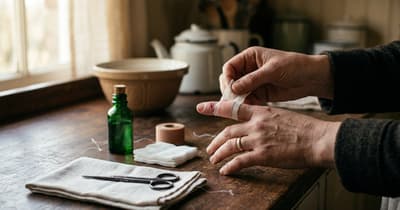
The standard fix in 1920 was awkward. A small wound usually meant cutting gauze, holding it in place, wrestling with surgical tape, and often needing another pair of hands. Dickson wanted Josephine to be able to bandage herself while he was away. So he laid little pads of sterile gauze along a strip of adhesive tape, covered the sticky parts with crinoline, and rolled the whole thing back up so she could snip off a ready-made dressing whenever she needed it.[2]
That kitchen workaround became the first Band-Aid brand adhesive bandage. Johnson & Johnson introduced it commercially in 1921, but the earliest version was not the tidy little strip in your medicine cabinet. It was huge by modern standards: roughly 18 inches long and a few inches wide, meant to be cut down to size.[3]
The clever part was not just the gauze or the tape. Both already existed. Dickson combined them into something a person could apply alone, quickly, and without much skill. The National Inventors Hall of Fame describes it as the first commercial dressing for small wounds that consumers could easily apply themselves.[4]
The product did not instantly take over American bathrooms. Early sales were sluggish, in part because the first strips still required scissors. Johnson & Johnson eventually put Band-Aids into the hands of Boy Scouts, giving away samples to troops around the country. That practical audience helped spread the habit. By 1924, the company was machine-making smaller ready-to-use bandages, and by 1939 it was selling sterilized Band-Aids.[2]
The story has a funny scale problem. The invention began with Josephine Dickson nicking herself in the kitchen, but it helped create an entire consumer category. A century later, Band-Aid is so familiar that the brand name is often used as a generic word for adhesive bandages in everyday speech.[5]
That is why this little strip matters. Not every invention starts as a laboratory breakthrough or a grand industrial plan. Sometimes it starts with someone noticing that a loved one keeps getting hurt, then asking a humbler question: why is the obvious solution still so hard to use?