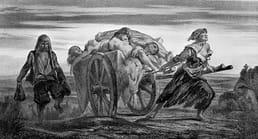
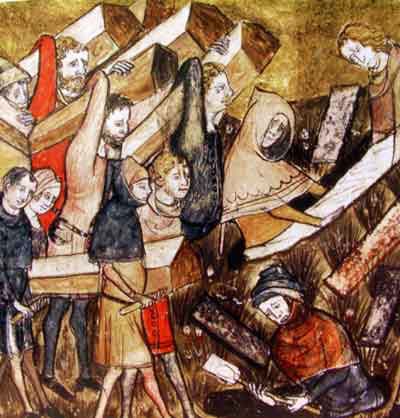
In a fourteenth-century miniature from Tournai, the living bend over the dead with the exhausted practicality of people doing work that has become ordinary. Bodies are being buried. The scene is cramped, but the pressure inside it is enormous: every grave meant one fewer hand for the fields, one fewer tenant for a manor, one more lord discovering that land without labor was not the same thing as power.[1]
The Black Death helped begin the end of feudalism and manorialism in much of Western Europe by killing so many workers that surviving peasants could demand higher wages, move more freely, and look for better terms in towns and on other estates.
The plague peaked in Europe between 1348 and 1350, and many estimates describe the loss as roughly a third of the continent’s population. Other accounts place mortality in affected regions between 30 and 50 percent.[1][2] Medieval Europe had known famine and disease before. What made this catastrophe different was the scale, because rural society rested on a blunt imbalance: many peasants, fewer lords, and land controlled through custom, obligation, and inherited rank.
After the burials, the arithmetic changed. The manor had assumed that peasants could be held to old duties because labor was plentiful. But fields still needed plowing, grain still needed cutting, and rents still had to be collected. Surviving workers became scarce, and scarcity gave them leverage. One summary of the plague’s consequences notes that many surviving English peasants saw their position improve, with plentiful land, higher wages, and serfdom largely disappearing in many places by the fifteenth century.[1]
When Labor Became the Valuable Thing
A peasant who had once been tied to a lord’s estate could now find that another landlord, another village, or a town needed workers badly enough to offer better terms. Accounts of medieval labor after the Black Death describe peasants gaining bargaining power as the labor supply dwindled, with surviving workers able to seek higher wages and better conditions.[2] The catastrophe did not make ordinary life easy. It made labor expensive.
Florence shows the shock in numbers. Its population fell from about 110,000 in 1300 to about 35,000 in 1350, then recovered to somewhere between 70,000 and 100,000 by 1400.[2] Across Europe, one reconstruction cited in the labor exhibit describes urbanization rising after the Black Death, from 8 percent to 11 percent by 1400, because urban areas recovered faster than rural ones.[2] Towns needed hands, skills, sellers, carriers, builders, and servants. For a worker, movement could become a bargaining tool.
The feudal order did not vanish in a season. Lords resisted, authorities tried to control wages and movement, and old obligations had deep roots. But the plague revealed a weakness at the center of the system. A lord might own land, collect dues, and claim authority by birth, yet fields did not cultivate themselves. Once too many workers were gone, the person holding the plow mattered more than before.
That shift helped open space for towns, wages, trade, and a broader merchant class. One account of feudalism’s decline describes peasants leaving rural estates for growing towns and identifies the rise of wealthy merchant classes as part of the pressure on the older manorial economy.[3] The change was not a clean invention of the middle class. It was a long rearrangement forced by empty cottages, abandoned strips of land, and lords competing for the labor they had once taken for granted.
So the Black Death’s role in ending feudalism was not only political or legal. It was physical. A manor could keep its charter, its fields, and its lord. What it could not easily replace was the missing worker at harvest, the empty place where someone with a sickle used to stand.