In Vysoká, Bohemia, religious tolerance had a shape. The church could be built, but it could not have a tower. It could not look too much like a church. It could not even open directly onto the street.[3] Joseph II had granted permission, but permission still arrived by the side door.
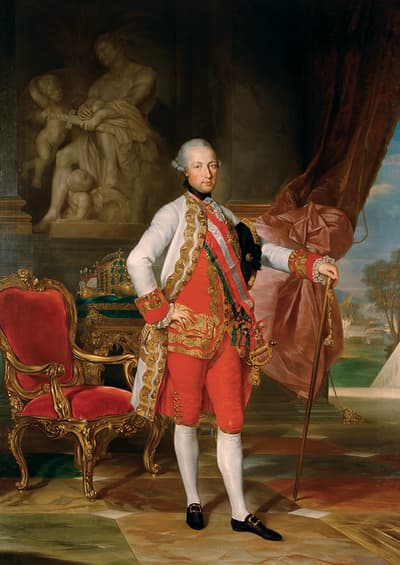
Josephinism was Emperor Joseph II’s ten-year campaign to remake the Habsburg monarchy as a centralized Enlightenment state. He loosened serfdom, expanded rights for religious minorities, pushed schools and medicine, and tried to put the Catholic Church under state control, but resistance left much of the program uneven or short-lived.
Joseph was born in 1741 to Maria Theresa of Austria and Francis I, and his education was steeped in the Enlightenment language of reason, order, and careful administration.[1] The Habsburg monarchy he inherited was not a tidy machine. It was a layered empire of crownlands, feudal duties, local privileges, church authority, and provincial exceptions.
For fifteen years, Joseph had a crown without full control. After his father died in 1765, he became Holy Roman Emperor, but in the Habsburg lands he remained junior co-ruler with Maria Theresa until her death in 1780.[1] Some reform had already begun under her rule, including restrictions on church property, the suppression of 71 of 467 monasteries in Lombardy, and limits on certain feudal obligations in Bohemia.[1] Once Joseph ruled alone, he tried to accelerate the whole project.
One account of his reign counts 6,000 edicts and 11,000 new laws, aimed at regulating and reordering nearly every part of the empire.[4] He was not a democrat. He was an enlightened absolutist, convinced that better lives could be produced from the center, by command, according to reason and efficiency.[4]
The Emperor Who Tried to Rewrite Daily Life
On November 1, 1781, Joseph issued patents for Bohemia that changed the legal relationship between peasants and their lords. They abolished lordly fines and corporal punishment, removed noble control over a serf’s marriage, movement, and occupation, and allowed peasants to buy hereditary ownership of the land they worked.[2] Landowners resisted, enforcement varied, and in the wider empire serfdom was not fully abolished until 1848.[2][4]
The same year, the Patent of Toleration granted religious freedom to Lutherans, Calvinists, and Serbian Orthodox Christians in the Habsburg lands.[3] In 1782, the Edict of Tolerance extended religious freedom to Jewish communities.[3] Protestants from less tolerant countries could immigrate and work as pharmacists, carpenters, blacksmiths, and in other trades.[3]
The permissions came with visible restraints. Non-Catholic congregations could be limited to private worship, and a church could be built only under certain conditions. Even then, it could be required to have no street entrance and no obvious churchlike appearance.[3] In Bohemia, Catholic officials printed explanations of the edict in German, though many of the people affected could not read or speak German.[3]
Joseph’s orders reached classrooms, too. He continued education and public health reforms begun by Maria Theresa, made elementary schooling compulsory, created scholarships for talented poor students, and allowed schools for Jews and other religious minorities.[4] In 1784, he ordered instruction shifted from Latin to German, a volatile decision in a multilingual empire.[4]
The fiercest fight centered on the Catholic Church. Joseph wanted church affairs in his territories, outside core doctrine, placed under state regulation and supervision, including administration and clerical discipline.[5] He did not reject Roman Catholicism as the historical church of his lands, but he did want it subordinated to the state’s larger order.[5]
Nobles, clergy, provinces, and local communities pushed back against a reform program that often felt less like liberation than intrusion.[4] Joseph died in Vienna in 1790, after a decade of rule that had moved faster than much of his empire could absorb.[5] What remained was an emperor remembered as enlightened, and a church in Bohemia allowed to stand, without a tower, with its door turned away from the street.