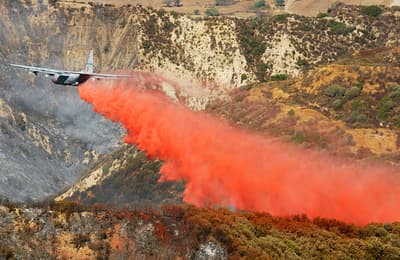
The red slurry pouring from a tanker plane during a wildfire looks like emergency made visible. It stains trees, rooftops, roads, and hillsides. It looks chemical in exactly the way people mean that word when they are worried. And it is chemical. But here is the strange part: some of the same material dropped to slow a fire is also, quite literally, plant food.[1]
That sounds like a contradiction until you understand what the red stuff is designed to do. Long-term fire retardants such as Phos-Chek are not primarily meant to smother flames the way water does. They are usually dropped ahead of a wildfire, onto vegetation and structures that have not burned yet. The goal is to coat fuel before the fire arrives and change the chemistry of combustion itself.[1]
So the image people remember, a red cloud pouring from a low-flying aircraft, is only the theatrical part. The real story is quieter. It is about altering what happens when heat reaches grass, brush, and timber. And to do that, firefighters rely on compounds that have an odd second life in agriculture.
The Firefighting Trick Is Chemistry, Not Just Water
Phos-Chek, one of the best-known wildfire retardant brands in the United States, has been around since the 1960s. It is manufactured as either a dry powder or a concentrated liquid, then diluted with water before use.[1] It can be delivered from the ground or from aircraft, including Modular Airborne FireFighting Systems fitted into C-130 planes.[1]
Its long-term retardants are commonly based on ammonium phosphate or ammonium sulfate salts.[1] Those names matter. When vegetation is heated, these compounds help redirect the process away from flammable gases and toward char and water vapor. In other words, they make plants harder to ignite and slower to burn. That buys firefighters time, and in a fast-moving wildfire, time is often the whole game.[1]
The water in the drop helps place the retardant. The real staying power comes from what is left behind after the water evaporates. That is why it is called a long-term retardant. The protection does not vanish the moment the hillside dries out.[1]
Why It Is Bright Red in the First Place
The red color is not there for the fire. It is there for the humans. Crews need to see where a drop landed, whether a line is continuous, and where another pass is needed. Phos-Chek formulations use colorants for visibility, creating those dramatic crimson streaks that can make a mountain look as though it has been marked with giant paintbrushes.[1]
That visibility is operationally useful, but it also disguises what the material really is. Strip away the color and look at the active ingredients, and you find something surprisingly familiar. Ammonium phosphate is not just a firefighting chemical. It is also used as a fertilizer.[1]
The Weird Fertilizer Hidden in the Fire Retardant
This is the part that feels backward. A substance dropped in the middle of an ecological crisis turns out to contain nutrients plants know exactly how to use. Phosphates and ammonium compounds deliver phosphorus and nitrogen, two of the major ingredients behind plant growth. That is one reason the retardant can function, in effect, as a fertilizer after the emergency has passed.[1]
In fact, that has been noted as one of the environmental side effects of retardant use. Because these chemicals can fertilize the landscape, they may encourage regrowth in treated areas. That sounds benign until you remember that ecosystems are not lawns. A growth boost is not always neutral. It can alter plant competition and, in some cases, help invasive species along with everything else.[1]
So the red line on a hillside is doing two things at once. First, it is trying to stop the hillside from burning. Later, after rain and time do their work, it may also be feeding whatever grows there next.
A Fire Line That Can Change the Landscape After the Fire
That double identity helps explain why retardants are both useful and controversial. On one level, they are a straightforward tool of wildfire suppression. They are applied to homes, vegetation, and fire lines because slowing combustion can save structures and give crews a fighting chance.[1] On another level, they do not simply disappear without consequence. Their ingredients enter the environment, and nutrients introduced in the wrong place or in the wrong amount can reshape what returns after the flames.
That is the quiet irony. We tend to imagine firefighting as a purely defensive act, a way of freezing a landscape in place. But retardant does not just preserve. It intervenes. It changes the chemistry of burning in the present and can change the chemistry of growth afterward.[1]
Which means the famous red drop is not only a barrier. It is also, in a literal sense, an application of nutrients from the sky.
The Real Surprise
What makes this fact stick is not that wildfire retardant contains chemicals. Of course it does. What makes it memorable is that the same material sits at the intersection of two opposite-seeming ideas: stopping destruction and encouraging growth. It is designed to interrupt fire, yet part of its legacy can be to fertilize the ground beneath it.[1]
That does not make it magical, and it does not make it harmless. It makes it more interesting. The red stuff dropped from airplanes is not just dramatic colored liquid. It is a deliberately engineered compromise, visible enough for pilots, persistent enough for firefighters, and nutrient-rich enough that, once the crisis has passed, the landscape may remember it as food.