A receipt is a humble piece of paper, the sort of thing people ask for after buying flour or settling a hotel bill. At Castillo de San Marcos in St. Augustine, Florida, it became the price of handing over a fortress.
When Confederate forces came for Castillo de San Marcos in 1861, the Union had left only one soldier behind as caretaker. He refused to surrender the fort unless the Confederates gave him a receipt, so they did, and the transfer happened without a shot fired.[1]
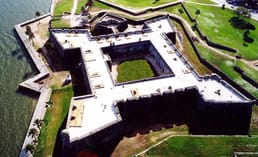
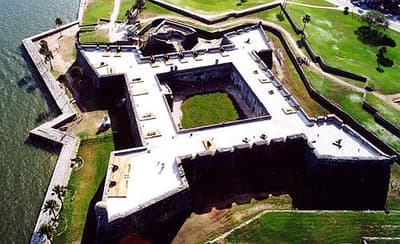
The walls around that exchange were anything but flimsy. Built by the Spanish between 1672 and 1695 on the edge of Matanzas Bay, Castillo de San Marcos is the oldest masonry fort in the continental United States.[1] Its coquina stone, made from compressed shells, helped the fort endure cannon fire, sieges, occupations, and the long habit of flags changing above St. Augustine.[1]
By the middle of the 19th century, the old Spanish stronghold had already lived several political lives. It had been Spanish, British, Spanish again, and then American. Under United States control it was known as Fort Marion, though the structure beneath the name remained the same heavy coastal fort, spread across more than 20 acres in St. Augustine.[1]
Then Florida moved toward secession. Federal troops withdrew from the post, and one soldier was left behind to look after it.[1] The scale of the arrangement is what makes the story stick: a harbor fort built for empire and artillery, reduced for a moment to a lone caretaker and the rules he believed he still had to follow.
When Confederate troops arrived, they did not have to batter the walls. There was no cannonade across the bay, no last stand in the casemates, no smoke over the moat. The caretaker was willing to turn over the fort, but he would not do it casually. He wanted proof that the property had been surrendered properly. He demanded a receipt.[1]
The Confederates gave him one.[1]
That small act of paperwork was enough. Castillo de San Marcos passed into Confederate hands without a shot being fired.[1] In a war remembered through battlefields, torn uniforms, and casualty lists, this transfer survives in a different register: a massive fort, a lone soldier, and the insistence that even surrender ought to be documented.
The Confederate hold on the fort was brief compared with the Castillo's long life. Union forces returned to St. Augustine in 1862 after Confederate troops evacuated the city, and the old fort came back under United States control.[1] Later it would be preserved as a historic place and recognized as Castillo de San Marcos National Monument.[1]
Visitors now tend to notice the stone geometry first: the bastions, the open courtyard, the view toward the water. The fort can look permanent, almost geological, as if it has always belonged to the shoreline. But for one odd moment in 1861, its transfer depended on a caretaker making sure that if someone was going to take the fort, they were going to sign for it.