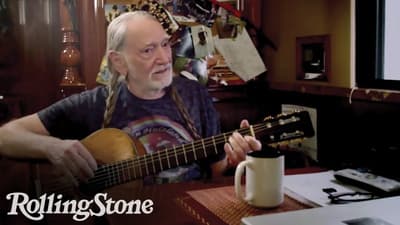
On a night in 1969, after a show at Floore's Country Store in Helotes, Texas, a drunk man stepped on the Baldwin 800C that Willie Nelson had been testing. Band members David Zettner and Jimmy Day carried the wreck to luthier Shot Jackson in Nashville, who judged it beyond repair [1]. Jackson offered a Martin N-20 instead: nylon strings, Brazilian rosewood body, Sitka spruce top, serial number 242830 [1][5]. Nelson bought it without seeing it, for $750 [1][6].
The instruction Nelson gave Jackson by telephone was to salvage the electronics. Jackson pulled the Prismatone pickup and preamp out of the Baldwin and, rather than fit them to the new Martin's bridge, replaced the entire bridge with the Baldwin's, mounting holes and all [1][6]. An amplified nylon-string guitar played with a flatpick was unusual at the time. Music journalist Joe Nick Patoski said no acoustic guitar had been successfully amplified with a pickup before [7]. The result became Nelson's signature tone [1][8].
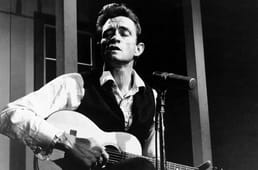
The Martin behind it came from a shop founded in 1833 in New York City and moved to Nazareth, Pennsylvania, in 1839 [3]. Martin built the N-20 in small numbers; the model was first catalogued in 1969, and only 262 were made that year [6]. The company's roster of prominent players includes Nelson and Johnny Cash [3], the Arkansas-born singer known as the Man in Black [4].
Nelson waited roughly two decades before giving the guitar a name. He took it from Roy Rogers' horse, and his standard explanation was short: "Roy Rogers had a horse named Trigger. I figured, this is my horse!" [1]. He had wanted a sound closer to that of Django Reinhardt, the gypsy-jazz guitarist he admired [1][7].
Nelson's ranch in Bandera, Texas, caught fire, and he ran inside to pull out Trigger along with a pound of marijuana [1][7]. He read the blaze as a reason to move, and after he settled in Austin his music changed [7]. Trigger is on Shotgun Willie, Red Headed Stranger and Stardust [1][2].
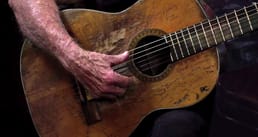
Decades of flatpicking have scraped a hole in the spruce above the bridge, close to the sound hole [1][6]. The steel frets, original to the guitar, have worn from smooth ridges into wavy lines across more than 10,000 performances [1][5]. Luthier Mark Erlewine once braced the hole with spruce patches, but Nelson wore through them, so Erlewine switched to Honduran mahogany [6]. Nelson has refused a pickguard: "I need a place to put my fingers" [7].
The first signature on the soundboard came from Leon Russell, who asked Nelson to scratch his name into the wood rather than write it, arguing the guitar would be worth more that way [1]. Nelson liked the idea and asked Russell to sign Trigger in return [1]. More than a hundred names now cover the top, from friends and fellow musicians to lawyers and football coaches [1].
Erlewine has handled repairs since 1977, when he met Nelson in a bar, and the guitar still comes to his Austin shop once a year for a check-up [1][6]. For four decades "Tunin' Tom" Hawkins set up Trigger before each show; Hawkins died in February 2026 [1]. When the IRS moved against Nelson in 1990 over $32 million in claimed back taxes, he told people, "When Trigger goes, I'll quit" [1][2]. His daughter Lana carried the guitar to Maui, and his attorney Joel Katz kept it hidden until the debt was settled in 1993 [1][7].