
A tablet recovered from the library of Ashurbanipal lists the portents that could set the substitute king ritual in motion: eclipses of the moon, the sun, Jupiter, Venus, Mercury, Saturn and Mars [1]. Mesopotamian priests read such an eclipse as a warning that the king himself would die. Their remedy was to hand the throne, and the doom attached to it, to somebody else [1][2].
Not every eclipse triggered the rite. Tablet 20 of Enuma Anu Enlil, a collection of astrological omens, states that if a lunar eclipse occurs while Jupiter is present, the king is safe and a noble dignitary will die in his stead [1]. A solar eclipse with Venus and Jupiter both visible meant the king would survive but an enemy would attack the country [1]. Otherwise the omen pointed to the death of a powerful king, whose identity had to be worked out separately [1].
Priests read the identity of the doomed ruler from the eclipse itself, using its date, its time, the direction of its transit and the part of the moon or sun's disc that was obscured [1]. The disc was divided into four quarters matching four regions of the Assyrian world: Amurru to the west, Elam to the east, Subartu to the north and Akkad in the south [1]. A darkened quadrant endangered that region, and a total eclipse endangered everyone [1].
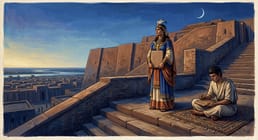
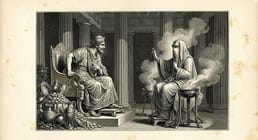
Once the danger was confirmed, the king symbolically gave up his throne and a substitute took his place [1]. The substitute held no real power, but he lived and held court in the palace and enjoyed royal wealth and prestige, while the real king went into hiding and saw only his closest advisers [1]. The stand-in was dressed in royal robes, given a woman as his queen, and provided with a small court [2][3]. The true king, meanwhile, was referred to as a farmer, or ikkaru [3][4].
In Akkadian the substitute was called the šar pûhi, and he was usually drawn from the lower levels of society: prisoners, slaves or commoners [2][3][4]. The choice served a purpose. A man of no standing could absorb the divine punishment without becoming a rival claimant to the throne [2].
The ritual ended with a killing, and attested performances are relatively rare [1]. Exorcistic rites transferred the danger from the king onto the substitute, and once the eclipse or the omen period had passed, the substitute and his queen were executed [1][2][5]. The Neo-Assyrian king Esarhaddon, who reigned from 681 to 669 BC, used the procedure at least three times in his final years, according to letters of the period [4]. One substitution lasted 100 days, and another followed the lunar eclipse of Tebetu 15 in 671 BC, when the man chosen was Damqî, son of the chief priest of Esagila in Babylon [4].
The best known substitute king came from a garden. Erra-imitti ruled the city state of Isin, about 32 kilometres south of Nippur in modern Iraq, between 1805 and 1799 BC on the short chronology [3][4]. After eight years on the throne his priests announced an approaching eclipse, and he selected one of his gardeners, Enlil-bani, to sit on the throne in his place [3][4]. Enlil-bani was crowned and waited to be sacrificed. Erra-imitti then died suddenly while eating hot porridge [3][4].
When the eclipse passed, the priests told Enlil-bani to step down. He refused, arguing that a king had already been sacrificed and that his own coronation made him the legitimate ruler, and the priests accepted the claim [3][4]. He reigned for 24 years [3][4]. The story survives only in much later Babylonian copies and may be apocryphal [3][4]. The ritual behind it is better attested: three cuneiform tablets in the British Museum were published in 1958 by Wilfred G. Lambert as part of the ritual for the substitute king [3][4].