The first author in recorded history did not live in Athens, Rome, or Shakespeare’s England. She lived more than 4,000 years ago in Mesopotamia, pressed her words into clay, and then did something that still feels startlingly modern: she signed her work.[1][2]
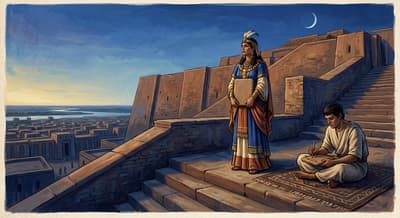
Her name was Enheduanna. She was a high priestess at Ur, usually identified as a daughter of Sargon of Akkad, and scholars now treat her as the earliest known author whose name survives alongside her writing.[2][3][4] That detail matters more than it sounds. Ancient literature is full of anonymous brilliance, but Enheduanna steps out from behind the text and says, in effect, this is mine.[1][4]
One line from the temple hymns is the ancient equivalent of a byline. As the BBC notes, Enheduanna identifies herself as “the compiler of the tablet” and then boasts that what she created had not been made before.[1] You can feel a person there, not just a civilization. That is the real jolt. The oldest named writer on Earth is not a vague legend. She has a voice.
She also had a job bigger than poetry. Enheduanna served at the temple of the moon god Nanna in Ur during the Akkadian Empire, around the 23rd century BCE.[2][4] According to the Morgan Library and other scholars, her role was both religious and political, because priests and priestesses helped organize power in the ancient city-state world.[3][4] This is where the story gets even better: her writing may have helped hold an empire together.
Sargon’s empire joined Akkadian-speaking rulers in the north with Sumerian cities in the south, and that kind of expansion creates a basic problem you still recognize today. How do you make different communities feel like they belong to the same system? Enheduanna’s hymns appear to have helped merge local traditions, especially around the goddess Inanna and her Akkadian counterpart Ishtar, into a more unified religious imagination.[1][4] In other words, some of the earliest named literature we have was also a form of statecraft.
Her work lasted. Texts attributed to Enheduanna were copied by scribes for centuries after her death, which is one reason her name endured at all.[1][4] Modern readers only rediscovered her in the 20th century, after archaeologists unearthed objects bearing her name, including the famous calcite disk that shows her in ritual procession.[1][3] She had been forgotten by the modern world, but not by the clay.
That is why Enheduanna feels so contemporary. She reminds you that authorship is not just about writing something down. It is about stepping forward and attaching a self to the words. Four millennia before the paperback, before the printing press, before the novel, a woman in ancient Iraq was already doing that. The oldest byline we know is also a quiet argument that culture, power, and personality have always been tangled together.[1][2][4]