By the fall of 1958, Else-Marie Larsson was striking her husband in the chest to bring him back. Arne Larsson was 43, a former ice hockey player, and his heart was stopping so often that he could lose consciousness as many as 30 times in a day.[1]
Arne Larsson became the world’s first patient to receive a fully implantable cardiac pacemaker in 1958. The first device failed within hours, but he ultimately received 26 pacemakers, lived another 43 years, and died at 86 from cancer.
Else-Marie had read that surgeon Åke Senning and engineer Rune Elmqvist were working at Karolinska Hospital in Stockholm on a pacemaker that could be placed entirely inside the body.[1] Senning and Elmqvist were still wrestling with basic questions, including how strong the electrical current should be and how many impulses per minute might stimulate a failing heart.[1]
She kept contacting them. Her persistence helped force the desperate case forward, and on October 8, 1958, Larsson underwent secret emergency surgery for the first fully implantable pacemaker.[1] The device was improvised under pressure. Elmqvist molded the components in a simple plastic cup with synthetic resin.[1]
A Machine Inside the Prototype Era
The pacemaker stopped working after only a few hours.[1] Doctors implanted a replacement the next morning, and that second unit worked for six weeks, long enough to show that the small electrical object inside Larsson’s body could do what his heart could no longer reliably do on its own.[1]
At the Karolinska Institute in Sweden, the 1958 operation used a device designed by Elmqvist and implanted by Senning, with electrodes attached to the heart muscle by thoracotomy.[2] Some historical summaries give slightly different durations for the first replacement, but they agree on the essential strangeness of the moment: the first implanted pacemaker patient began with a device that failed almost immediately.[1][2]
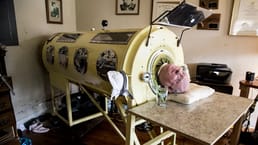
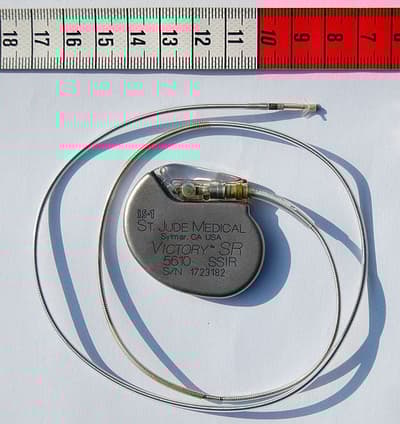
Only a few years earlier, cardiac pacing had looked much less like hidden medicine. The first cardiac pacemaker, invented in 1952, was about the size of a small television and had to be pushed around like a shopping cart.[1] By 1957, smaller versions could be worn around the neck like a pendant.[1] Larsson’s operation moved the machine under the skin.
Twenty-Six Pacemakers, Forty-Three More Years
Larsson did not receive one pacemaker and disappear into medical trivia. Over the rest of his life, he went through 26 pacemakers in total.[3] Another account describes those decades as a chain of replacements and upgrades, from bulky rechargeable models toward smaller, more reliable lithium-battery versions.[4]
Each replacement turned the famous “first patient” into a continuing test of a changing technology. Larsson had to keep returning to the operating room, then trusting the next machine. He lived another 43 years after the first operation.[3]
On December 28, 2001, Larsson died at 86 at his home in the Stockholm suburb of Saltsjoe-Duvnaes.[5] The cause was skin cancer, not the heart condition that had once made him a desperate candidate for an experimental implant.[3][5] Else-Marie later said he knew that without the pacemaker, he would have died at 43.[5]
Elmqvist reportedly saw the pacemaker at first as “a technological curiosity, more or less.”[1] Larsson outlived Elmqvist, who died in 1996, and Senning, who died in 2000.[4] The man whose heart once needed his wife’s fist to restart it lived long enough to carry 26 versions of the future in his chest.